Showing posts with label twi. Show all posts

Sunday, August 5, 2012

Kwame Yeboahkrom and the Death of a President– July 24th 2012

After another few trips into the magazines of Kumasi, the welding and parts for the generator set-up had all been completed and found for the lister engine project in Kwame Yeboahkrom.  Our caravan started with Mike and Chelsea returning from Kumasi along with Govina and Peter in a truck full of everything we were bringing.  Then at Sunyani Clayton switched in with Mike and headed out towards Dormaa and the village areas; Helena and Chelsea tro-troed their way there separately. 
            While we were riding in the truck, Govina began to hear rumors from his friends that something had happened to the President.  It turned out the President of Ghana, Atta Mills, had died in office.  We were told that rumors of his death were not uncommon since his health has been bad in recent years, but this time the rumor was true.  It’s a particularly strange time for such an unfortunate thing to happen because he was campaigning for reelection in the Ghanaian Presidential vote this December.  Now his VP, John Mahama, has been sworn in and will continue the elections.  Many people are wearing the red and black funeral cloth during the day, and the newspapers tell us there is a period of national mourning that will now extend until the late President’s funeral on August 10th. 
Going back to our village trip, we arrived at the village and we could see the small building they had constructed to house the lister engine.  They showed us inside we could see the villagers had already poured a concrete base and mounted the engine in position on top of it.  By luck there was a man in the nearby town of Ankrankwanta who had years of experience working with the kind of engine similar to ours, and he was a great assistance.  With a fresh can of diesel, motor oil and a little bit of cranking, the lister engine originally ordered by a previous Pavlis group started chugging happily away.
Most of the rest of our work was letting Peter set up the wiring and breakers to deliver power across the yard to the clinic, and setting up and mounting the generators itself.  We spent a while trying to communicate how we wanted the generator placed in relation to the engine, where the studs needed to be to secure it, how to align the belt, etc.  Nearly 20 members of the village surrounded us whenever we worked around the engine, and there was a lot of discussion in Twi we couldn’t catch over the plans we suggested.  Even the local village chief, Nana Yeboah, was into the discussion, and once we had established the spot for the generator and they began to pour the concrete, he was right down with everyone working and getting his hands dirty.
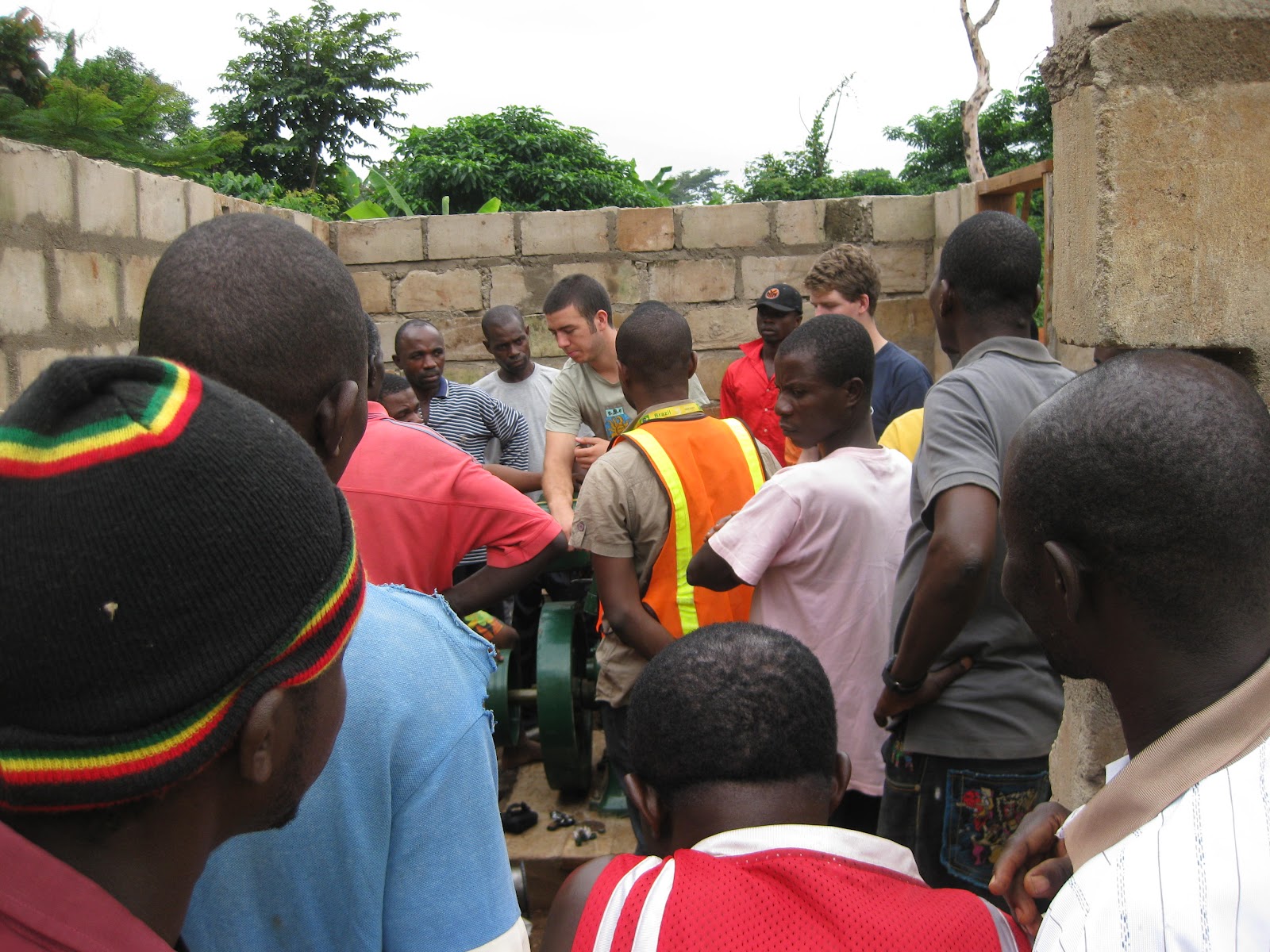
Mike working on the engine with an audience
Unfortunately one thing that went wrong was that the coolant system Mike had envisioned did not fit to the lister engine, and so we will just need to find a few parts in Kumasi and then return again for a day trip to set it up.  The concrete for the base did not dry during our stay, and so we also need to return to actually test the generator.                       
Our plan was to stay two nights in the Kwame Yeboahkrom and leave on the third day, so we stayed inside the spare rooms of the clinic that were kindly offered to us.  During the night of the President’s death we were invited into the downtown area of the village to have dinner at the chief’s house.  It was fascinating to actually be staying in one of the more remote villages in Ghana and seeing a little bit more of what life was like day and night.  Outside the chief’s house we waited for a while under a solar-powered street lamp and a good number of the village residents came and gathered around the area to take a look at us.  The children got a big kick out of our attempts at Twi and many of the older villagers were fascinated by Helena and Chelsea’s hair.  After the dinner of rice and hard-boiled eggs with spicy tomato sauce, the village had a small funeral celebration dance in honor of the late President Mills.  Govina was still with us, and pushed us to lead the dancing.  The music was loud and a lot of people showed up to join or just watch the obroni trying dance the popular Azonto dance.
The following morning before we got to work, Nana Yeboah showed us around his village.  The first day he showed us a cocoa plantation, and we learned that the majority of the people of Kwame Yeboahkrom are cocoa farmers.  We had never seen anything like the big yellow and green pods sticking out of the cocoa tree trunks, and later Nana invited us to try some of the dried beans from the pods that tasted exactly like unsweetened chocolate.  The next morning he showed us the palm farms, where the trees were either cut down and tapped to harvest the sweet and tangy sap, or left standing to produce palm fruit, then processed into palm oil, an extremely popular cooking oil in Ghana.

Dried cocoa beans and two picked cocoa pods pictured
Written by Clayton

Tuesday, July 17, 2012

Greeting the Town- July 10 & 11

Tuesday the 10th was a day filled with going to the Sunyani open market for ingredients for dinner (we always have particular fun at the stand where we buy eggs, because the friendly women there, Nana Afia and Nana Yaa, always try to teach us a few new phrases of Twi when we visit), compiling our video footage, and doing a bit more writing for project documentation. At the end of the day, Mike, Chelsea, Mollie, and Helena went for a run along the street that goes by our dorms, during which most of the people who saw us go by either stared, laughed at us, or asked “Where are you going?”. As we realized later, people do jog around here, but the locals only go in the cool early morning hours.

One small section of the open market in Sunyani

Clayton holding one of the cocoyam leaves (similar in taste to spinach) we got at the market


On Wednesday, our morning was filled with errands and chores:  buying fresh food for the day, picking up a couple of science demonstration supplies, and filtering water.  Around noon, Emmanuel arrived (he had driven from Kumasi) to introduce us to a variety of individuals who will be instrumental throughout the remainder of our stay in Sunyani. 

We were introduced to Andy Ampong, the new headmaster at Ridge Experimental Junior High School, a site of donations and lessons from previous Pavlis cohorts.  Then, on our way to briefly visit another project location, the Abesim Community Center, we stopped in at the Sunyani Municipal Assembly, where we met the director and made future plans to meet with the Sunyani MCE (Municipal Chief Executive)- the official who has taken responsibility for the payment of our book shipment.

Emmanuel knows just about everyone in Sunyani, so our greetings did not stop there.  We stopped downtown and met Emmanuel’s mother-in-law, Comfort, at her local business, the Glory Pharmacy.  We drove to see the beautiful home of the Regional Minister and waited outside a meeting of all the area MCEs for the chance to be formally introduced to Kwasi Oppong Ababio, the Sunyani MCE, with whom we planned to meet the next day.

We met with the head chancellor of Sunyani’s new local environmental and natural sciences university (to be called ENAT) and became acquainted with Dr. Solomon Fofie, the head physician at Sunyani Polytechnic (another local university).  We also drove to see the Sunyani Regional Hospital, the workplace of Dr. Jacob, one of our main contacts for assessing medical needs in the area.

After this full day of greetings and introductions, Emmanuel delivered us back to our dormitory room and then headed back to Kumasi.  As for us, thoroughly worn out from meeting so many new faces, we made dinner (a spicy ginger/lime stir-fry), had our group meeting, and called it a night.   


*Note: This post was written by Chelsea.

Tro-Tros and Kwame Yeboahkrom – July 9


We're sorry for the delay again, everyone! We bought an internet modem last week, but the provider has been down, so we have had very limited internet access. We should be able to put up several new posts by the end of today, though. Thank you all for your patience! :)


***

We all awoke Monday morning wondering if the recently returned power was really all that appreciated. The local student radio station adjacent to our room greeted us at 5am blaring their music from a small radio in their room, disrupting all of our sleep. But we were still able to get moving at 7am to enjoy a nice breakfast of eggs, toast and avocado prepared by Mollie, Chelsea, and Helena, while Clayton and Mike slugged their way through their morning.

This was our group’s first day apart from one another. Helena, Chelsea and Mollie stayed in Sunyani to sort out tasks around our dorm, while Clayton and Mike set out to Kwame Yeboahkrom to deliver the Lister engine housing plans and create a parts list, accompanied by our Kumasi electrician friend Peter (pronounced “Peetah”). This trip was also another first because instead of using Emmanuel’s forestry trucks to get to the village, we took the famous Ghanaian tro-tros the entire way, which created quite an adventure.

Starting in Sunyani, the first tro-tro trip was to Dormaa, with Mike and Clayton crammed in the first row and Peter behind. We entertained ourselves by pointing out the various oddball ads, business signs and taxi slogans along the way.  One sign appeared to be trying to tell us not to simultaneously lead small chickens while playing the trumpet.  From Dormaa everyone packed himself into the back row of another tro-tro, said goodbye to pavement, and bounced, rocked, creaked and banged all the way to the village of Ankrankwanta. From there, we took one last tro-tro to the clinic in Kwame Yeboahkrom, arriving there a bit after noon.

Working with the clinic’s doctor and our tro-tro driver- who, coincidently, also is helping with our project- we discussed the plans for the generator housing. We decided on a 10’ by 12’ room with one door and three basic windows for ventilation. The engine will be bolted to the floor with four studs imbedded in the cement that were delivered with the engine, while all other components such as the generator will be screwed in place after the building is done.

While we were in Kwame Yeboahkrom, our driver showed us another Lister engine being used in the village, which was previously unknown to us. This engine was powering a small grain mill, so although we still need to create our own system to connect a generator to ours, we at least have a working reference for what is needed to get our engine running.

After seeing the motor, we returned to the clinic and ironed out the rest of the details. We then shared a quick friendly chat with the clinic’s doctor and after Clayton attempted to speak Twi to a small crowd of laughing girls, we set off again in the same series of tro-tro’s back home. Leaving a little after 4:00 in the afternoon, and arriving home to the dorms around 8:00, Clayton and Mike joined the girls for a nice dinner of rice, fried cocoyam (a potato-like tuber), and breaded garden egg (like a mini eggplant) along with their best interpretation of no-bake cookies with locally available ingredients, ending another long successful day.  

The girls had a full day too, but with less travel: learning more of the ins and outs of the Sunyani market, organizing information from our projects so far for documentation, putting up blog posts, and cooking with ingredients from the market!


*Note: This post was written by Mike, though he wasn't here to post it himself.

Monday, July 9, 2012

Hello Sunyani! - July 8


When we woke up on Sunday morning, the power was out again.  The early Ghanaian sun, however, made the absence of electricity considerably more bearable!  We took advantage of the morning to become more familiar with our new home.  We gained access to a shared kitchen space (with counter space, several sinks, and even a gas stove!), met a Canadian summer resident of the dormitories, and got a head start on unpacking and tidying up our rooms. 

In the afternoon, the five of us caught a taxi to Sunyani’s market.  We satisfied hunger with a stop to eat the bread and pies to which we had previously been introduced.  Then, armed with a list, we explored downtown Sunyani.  We bought items ranging from onions and avacados, to butter and eggs, and even a couple of bandannas.  The Ghanaians we interacted with (most still dressed in their Sunday best) were very friendly.  Many were happy to have our business and even happier when we were able to slip in a word or two of Twi (i.e. basic greetings, introductions, and thank you’s). 

Four squished into the back of a taxi
Chelsea trying her pie
Though the Sunyani market was considerably less overwhelming than Kumasi’s central market, we were tired after a couple of successful hours and returned back to our dormitories.  Helena, Mike, and Clayton were able to wash some clothes (a far more time-consuming task when done by hand).  An attempt at a run was made, but prematurely concluded on account of pouring rain and approaching darkness. The entire group then enjoyed a headlamp-lit (as the power had yet to return) Minestrone soup dinner, as deliciously prepared by Mollie, Helena, and Clayton.  After 8 PM we again had electricity and Mike was able to tape-out dimensions and complete drawings for the lister engine’s housing structure.  We then discussed plans for the approaching day, and called it a night.

Saturday, July 7, 2012

Journey – Akwantuo: July 2,3


On our second day in Ghana we were introduced to Sunyani, a city approximately two to three driving hours west of Kumasi.  We settled into rooms at the city’s KNUST satellite dormitory; we will use these rooms as a housing base throughout the rest of our stay in Ghana.  We spent most of the day running errands (i.e. securing plane tickets for our advisor’s departure, exchanging our US dollars for Ghanaian currency, the cedi, and outfitting our new residence with common household items such as hand soap and dish detergent.  On our trip to the Sunyani market, we stocked some of our in-country phones with minutes and we were even able to try a popular local snack, pies (meat and onion filled bread, a seemingly distant relative of the pasty!).  We ended the evening with an even more familiar dinner (pizza!) with our advisors at their local lodging, the Eusbett Hotel.

Beginning the next morning, we had a very full day of traveling around with our advisors.  We were off just after 7 am and on the road to Dormaa, just outside of Sunyani.  The road has many speed bumps/rumble strips with two or three small strips in the road in a row.  After meeting briefly with a representative for the regional minister, we continued on to Kwame Yeboah Krom (Kwame is a common first name, Yeboah is a common last name and Krom means village.) To put it mildly, the road was extremely rough on the way to the village. 

We met a local government representative near Kwame Yeboah Krom and he lead us into the village, where we were visiting the Lister engine, a simple engine that was ordered for the village two years ago and just arrived a few months ago.  Our goal for this trip is to facilitate the building of a housing structure for the engine, to buy a generator, and to try to get the engine up and running.  It was very exciting to practice our small Twi phrases, as most people in the village didn’t speak English.  The kids especially got excited! This was our first time visiting a more rural area, and we had an enjoyable, if short, time.
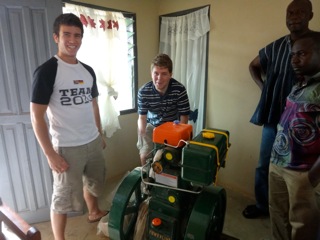
Mike and Clayton checking out the Lister engine           
After visiting the engine, we visited the local representative’s home in the neighboring village of Okirakrom.  When we visit again to work on the engine for a few days, we can stay at his house.  In the courtyard there were a bunch of orange trees that were heavy with fruit.  In Ghana, oranges are green on the outside, but orange and juicy on the inside.  What a treat!

From there, we continued on to the village of Duasidan to visit the Duasidan Monkey Sanctuary, a relatively unknown location that the locals would like to develop into an ecotourism site.  Here, a large group of kids flocked with us and our two guides a short way into the 40-acre plot of forest.  In a clearing of bamboo, one guide started tapping on the sticks and pretty soon, we were surrounded by monkeys!  We had brought peanuts and small bananas to feed to them and they snatched them right from our hands!  One of our projects is to help advertise the sanctuary to tourists, so we took a lot of photos and videos.  Emmanuel sat down with our two guides to help translate and we taped an interview with them. 
The group with two local guides (left and second from left) and one of our divers, Govina (third from left)

Monkeys!

Chelsea feeding a Monkey

Next, we traveled about 20 minutes to Babianeha, where Emmanuel’s family is from.  Emmanuel’s mother had prepared a huge and delicious lunch of chicken, a cocoyam leaf (like spinach) dish, and jollof rice for us! After a quick meal, we visited the community center that was founded by Pavlis students in the past, interacted with the children who were there reading books and using the laptop computers, and then took a short walk to the Ghana/Ivory Coast border.  We talked to the border officers and then crossed over briefly.  It was pretty much the same as being in Ghana except for a few French phrases.

After our short visit to the Ivory Coast, we headed back into the vehicles for the long drive back to Kumasi.  We finally got in around 8 pm, settled into a guesthouse for temporary lodging in the city, and then concluded the evening for dinner with our advisors at the Royal Basin Hotel.


Thursday, June 28, 2012

Cultural Expectations


We now have two days to go until our flight to Ghana! As we mentioned in our last post, we have spent the last six weeks preparing for our trip by learning a bit of the different aspects of Ghanaian culture. Previous Pavlis groups, as well as our TA Emmanuel spent a lot of time telling us about their own experiences. Here's a snippet of what we've learned!

Family
Relationships between family members are a lot closer than in the U.S., typically. One way this can be seen is in how relatives in Ghana are named; your father's brother, for instance, would not be referred to as your uncle, but as another father- and to suggest otherwise would be very disrespectful. The same idea would apply to your mother's sisters - they would also be called your mother. Likewise, all of your cousins would be considered your brothers and sisters. This is one reason why homelessness in Ghana was relatively rare until recently (that is, until greater urbanization and modernization began to set in), because extended families always provided support.
Our TA Emmanuel with his wife Ester and son Adom
Time
Ghanaians often jokingly refer to "Ghana Time"; not as a time zone, but as a way of life! They are typically much more relaxed in regards to punctuality, and it is not at all uncommon to show up two or three hours late to an appointment. So when a friend shows up late to lunch, there's no reason to be angry- just smile and laugh, and everything will work out the way it should.

Food
Ghanaian food boasts many kinds of soups, meat, starchy types of dough, and dishes utilizing the many fruits and vegetables available in Ghana. Some typical meals include: 

Fufu- a dough made from pounding plantains and cassava, usually eaten with soup 
Redred- a dish of fried plantains and oil from the palm tree fruit 
Kelewele- ripe plantain, hot pepper, and ginger 
Grasscutter- a type of large rodent, a specialty of Ghana's!
Banku- made of maize and cassava
Groundnut Soup- a peanut soup, usually served with meat as well
Jollof Rice- rice cooked with tomatoes and red pepper, among other ingredients

An example of a typical meal in Ghana [1]

Sugar is very uncommon in Ghanaian dishes, as are the use of ovens, so there are not many sweet or baked goods. Most meals are prepared on stovetop, and eaten with the fingers- yes, even the soups! ;)

Life and Death
Being married and having children are two of the most important values in Ghanaian society- so much so that when a Ghanaian meets you for the first time, instead of being asked "Do you have children?" you may be asked, "How many children do you have?" Many foreigners in Ghana will also tire of the frequent marriage proposals from strangers - some serious, some not! ;)

Also dissimilar to Western culture is Ghanaians' attitude towards the death of a loved one. Whereas American funerals are typically a solemn affair, funerals in Ghana are extravagant celebrations of life, with much food, singing, and dancing.

A funeral celebration in the Upper Volta Region of Ghana [2]

Social Life
Ghana has often been described as one of the friendliest places in the world- and probably deserves the title! While we have been warned to watch out for "professional friends" who make a living of scamming tourists, the majority of Ghanaians are genuinely eager to help out and meet new people. Of course, this doesn't mean that the sellers in the local market won't raise their prices as soon as an obruni (a white person) walks by, so we're practicing our bargaining Twi! 

Because social life is such an integral part of Ghanaian culture, greetings are also very important - if you do not greet someone when you meet them, they may believe you are holding a grudge against them. Also, left-handers beware; use of the left hand for shaking hands or even waving is considered an offensive gesture.


If you would like to learn more, we highly recommend the following books, which we read and enjoyed in our exploration of Ghanaian culture:

Utley, Ian.  Culture Smart!  Ghana.  New York:  Kuperard, 2009.
Wyss, Susi.  The Civilized World:  A Novel in Stories.  New York:  Holt Paperbacks, 2011.

The last two pictures in this post can be found at 
[1] Erose Blog <http://emmarose91.blogspot.com/2011/04/fufu-originated-from-ghana-where-it-is.html>  
[2] Chip Williams Photography <http://www.chipwilliams.com/#/travels/Ghana_Funeral_Dance>

Wednesday, June 13, 2012

Dinner With the Class

In preparation for our trip to Ghana, we have been taking a Language and Culture class for the past six weeks. This class is set up specifically for our group, as well as the other Pavlis group, which will be traveling to India.  For the language portion of the class, we split up into our travel groups and meet with a Teaching Assistant (TA) from our respective countries.  Last night our Language and Culture class shared a Ghanaian/Indian meal at our teacher Sylvia's house.  Our TA Emmanuel and his family came as well.  It was wonderful to meet Emmanuel's wife, Ester and his son, Adom, who turned out to be the life of the party!

Emmanuel, his son Adom, the Ghana Group and Emmanuel's "First Lady" Ester
For the dinner we made a West African peanut soup that was a hit with the Americans at the dinner, however it was deemed too sweet due to the creamy peanut butter we used in the recipe.  Speaking of sweet, we have learned that using sugar is rather uncommon in Ghana and that sweets are nowhere near as popular there as they are here.  Some students who have traveled to Ghana before have shared with us that they had a hard time satisfying their sweet tooth, especially with limited access to kitchen appliances such as an oven, fridge or freezer.  Our solution?  No-Bake cookies, made on a stovetop, with ingredients that should be available in Ghana such as peanut butter, chocolate, sugar, oats, milk and butter.  So in preparation for brining American food to Ghana, we made a test batch to bring to the class dinner.  Unfortunately most of the cookies were gone from "taste testing" the first batch, so we ended up making a second batch as well ;)

By the way, don't forget to check out our wish list of items to bring to Ghana.  Items must be ordered by this Friday and are all between $5 and $25!  Thank you so much!

Tuesday, June 5, 2012

Twi Names

Day of the week names are extremely common in Ghana.  You may recognize a famous Ghanaian, Kofi Annan, with his first name meaning Friday-born.  To find out what day of the week you were born on, enter your birthday into WolphramAlpha and then compare to this list:

Male:
Monday -Kwadwo
Tuesday - Kwabena
Wednesday - Kwaku
Thursday - Yaw
Friday - Kofi
Saturday - Kwame
Sunday - Kwesi

Female:
Monday - Adwoa
Tuesday - Abena
Wednesday - Akua
Thursday - Yaa
Friday - Afia
Saturday - Ama
Sunday - Akosua

Yaw, Akosua, Akua, Yaa and Kwabena

Monday, June 4, 2012

Meet the Team

Mike, Chelsea, Mollie, Helena and Clayton
There are five of us going to Ghana together and we're getting to know each other really well so we thought we'd share a bit with you!


Name: Mollie Ruth 
Major: Environmental Engineering
Hobbies: Playing Cello, Skiing, Sewing, Hiking and Camping
Project Interests: Shipping school supplies, water testing, biochar, tree planting, hygiene/microbiology lessons
Hometown: Ann Arbor, MI
Fun Fact: I've been to eight different countries (not counting airports)
Biggest Excitement for Ghana: Buying fabric in the markets
Favorite Word in Twi: Fεfε (beautiful) or fεfεεεfε (very beautiful) or fεfεεεεεεεεεεεfε (extremely beautiful)

Name: Michael Carey 
Major: Mechanical Engineering
Hobbies: Cars, engines, machines, building, biking, and skiing
Project Interests: Lister Engine, Planting tree's, Monkey Sanctuary
Hometown: Good ol' Shelby, MI
Fun Fact: This summer I'm driving my 40 year old project car as a daily driver, and I've learned that not every "improvement" I think I make is a good idea.
Biggest Excitement for Ghana: Seeing monkeys in real life and trying out the local beer
Favorite Word in Twi: M'adamfo (My friend)


Name: Helena Keller
Major: Chemical Engineering
Hobbies: Cross country skiing, running, knitting, swing dancing, gardening, clarinet and guitar playing (not at the same time...)
Project Interests: Biochar and the Duasidan Monkey Sanctuary projects
Hometown: Elk River, MN
Fun Fact: I have been skiing in July.
Biggest Excitement for Ghana: The music and dancing :)
Favorite Word in Twi: Hyehyeeeehye (very hot - weather-wise)


Name: Clayton Doyle
Major: Electrical Engineering
Hobbies: Banjo, Hiking, Film
Project Interests: Lister Engine Generator and Science Demonstrations
Hometown: Hopkins, MN
Fun Fact: I'm an Olympic-level gymnast and bad at lying.
Biggest Excitement for Ghana: Getting the chance to speak the language
Favorite Word in Twi: m'adamfo (friend)


Name:  Chelsea Uganski
Major:  Biochemistry and Molecular Biology
Hobbies:  Tennis
Project Interests:  Investigating medical needs/logistics, health and other education, tree planting, monkey sanctuary ecotourism plan
Hometown:  Whitehall, MI
Fun Fact:  I've never been outside of North America.
Biggest Excitement for Ghana:  Experiencing/learning from a different culture.
Favorite Word in Twi: Meda ase (Thank you!)