Showing posts with label food. Show all posts

Sunday, August 5, 2012

Goodbye Sunyani, Goodbye Friends – August 1


Packing this morning was pretty hectic!  We had to get every last item out of our dorm rooms in Sunyani so we could check out and head to Kumasi for the night.  Once we had everything packed into the cars, Mike and Clayton headed to Kumasi immediately to work on troubleshooting the generator for the Kwame Yeboah Krom.  Mollie, Chelsea, and Helena stayed with Emmanuel in Sunyani for much of the day completing last minute errands. 

First we dropped Chelsea off at the hospital so she could get information from him about the medical needs of the region, as well as to collect Mollie’s medical report from her stay at the Sunyani hospital.  Then we dropped Helena off in the main market for her to pick up a few items.  Finally, Emmanuel and Mollie visited the District Assembly to deliver the shipment allocation to the director and to receive reimbursement for the shipment costs. When we were all done with our errands we all went to meet the Regional Minister (similar to Governor of a state). 

We had been trying to fit our schedules to a time he could meet with us since our arrival, and we finally got it right.  After waiting about half of an hour for his meeting to finish up, we got to finally greet the Regional Minister on behalf of the team, and all of Pavlis.  We took a picture with him and the Sunyani MCE and then went across the street to have lunch with them. 

Emmanuel, Helena, the Regional Minister, Mollie, the MCE of Sunyani, and Chelsea
During that time Mike, Clayton, Peter and Govina were nursing the truck back to Kumasi with the generator. We switched trucks in Kumasi, so that Govina could get his truck properly fixed and we took off into the magazine. After fighting the usual stop and go traffic, we were directed to another electrician within the magazine who could check the health of our generator. After a few test the electrician told us that our problem was actually much simpler than we thought. The generator salesman told us the wrong neutral wire, and we had been using two live wires to check the voltage with light bulb, giving twice the required voltage. After seeing the generator light up a bulb using the correct wires, we knew everything was okay, and we set off to buy Peter a voltmeter so that he can check the generator at the site with more than a light bulb.

That night we were all in Kumasi again and as it was our last night there, Emmanuel and his family put on a party at their house with the whole family as well as some of Emmanuel’s students.  There was a delicious array of Ghanaian dishes including jolof rice, fufuo, goat soup, chicken soup and plain rice with a red sauce.  For dessert, Mollie baked an apple crisp because we found out that Adjoa’s (Emmanuel’s wife’s) favorite American food is apple pie.  It went very well with the vanilla ice cream and fresh mango slices that were also being served!

After dinner, dancing was the theme of the night, and with our friend Govina as DJ, it was hard to keep from tapping your toe to the music.  Luckily we had some help form the Ghanaian youngsters in learning the newest dance style in Ghana, Azonto.  The stars of the night were Emmanuel’s four kids though, because they were all getting in on the fun of dancing, even Kwaku at only 13 months of age!


Kwaku
Mike, Clayton, and Yaw eating ice cream
Mike and Clayton, with their electrician friend, Peter
Written by Mollie and Mike

Last Trip to the West – July 31


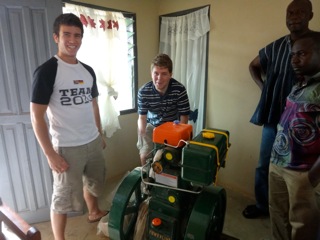
We started the day early with a 6:30 departure for Kwame Yebohakrom in one of the FORIG trucks, with what we hoped would be the last of the parts for the Lister engine project. With Govina at the wheel of the truck and Peter as co-captain we made quick time to the village arriving somewhere after 10, even with a quick stop for fufuo. The building for the engine was still unfinished but was complete enough to hopefully finish the project. After quickly bolting the generator up, tightening the belt in place we were ready to test our system. The engine was fired up, running as well as ever and the generator was spinning without vibrating out of place or throwing the belt. Everything seemed okay until Peter went to test the generators voltage with a standard light bulb, which was immediately popped. Concerned, we called the man we had purchased the generator from to learn that he misspoke when we told us the generator operating speed, and we were operating it at over twice what it should be running.

A man in Duasidan next to the covered Lister engine
Determined to finish the project, we decided after a bit of head scratching to try the second smaller pulley on the machine that was shipped with it to see if we could match the desired speed.  After a quick run to Nkran Kwanta to grab another belt and relocating the generator we fired the Lister engine up again for another test. Sadly, even though the generator was spinning at what should be the correct speed, the test light bulb was popped again. Even after turning the generator around to spin it in the opposite direction we were unable to get the correct voltage. Running out of time in the day, we decided to take the generator back to Kumasi to see if it had become damaged on its way to the project site. It was upsetting to leave the village with all our hard work unfinished, but we knew if the generator could be revived, our friend Peter would have no problem finishing the project after our departure.

Meanwhile the girls were dropped off at Duasidan in the morning to have one last meeting with community members regarding the monkey sanctuary advertisements and future work in the community.  We arranged with the printer in Kumasi for the road sign advertisements to be printed before our departure from Ghana and arranged for the Duasidan Assemblyman, Jacob, to post them at appropriate intersections en route to Duasidan.  The community expressed interest in forming a community center if future Pavlis students could provide supplies for it.  They even showed us which room in an old school building they could renovate for community use. 

After our formal meeting we requested that we could have a taxi called to pick us up.  It took three hours to actually get the taxi, but we passed the time playing with the huge crowd of kids that showed up.  Finally, the taxi arrived, driven by a nice guy called German, who dropped us off in Babianeha. 

Mollie and Helena with kids in Duasidan
In Babianeha, Mollie went with Victoria, Emmanuel’s cousin who will start University in September, to interview families in the village about their cooking habits.  It was really interesting to see the range of cooking methods used in the village all the way from very modern gas ranges in kitchens to open fires outside the house.  Meanwhile, Helena and Chelsea ran a few final errands around town, including dropping off a bag of biochar for the school garden. 

A typical outdoor fire for cooking
In the afternoon the girls traveled to Dormaa to speak with the MCE there.  However, because it was the one-week celebration of the president’s death, both the MCE and the Director were busy and so we got to meet the assistant director.  He was very enthusiastic about our efforts to advertize the Duasidan Monkey Sanctuary and he was especially excited about the website we hope to develop.  He was very optimistic about future development of the site by the Dormaa Assembly in collaboration with Pavlis!

After a long day of work everyone was ready to head home to Sunyani to have dinner with a delegation of people from the Sunyani MCE’s office as well as some other friends from Sunyani.  Just as Mike and Clayton were beginning to arrive in Dormaa to pick up the girls, their truck overheated, stalling on the road. The girls were sent on ahead to finish the journey by bus, just before realizing that Mike and Clayton had the only sets of keys to the dorm. Running quite a bit behind, the truck was quickly fixed and the guys quickly rushed home to change with the waiting girls and head to the dinner.

Despite being one hour late, we were still able to meet everyone for a wonderful dinner. The meal was a fancy buffet with two courses.  We all looked quite dashing in our newly tailored Ghanaian outfits if we do say so ourselves! 
The group with our friend Govina after the dinner (note his black clothing and red scarf worn in honor of the one week celebration of the president's death) 
Written by Mollie and Mike

The Whole Group in Kumasi – July 27-28


 On Friday the 27th, the group was all in Kumasi.  Clayton and Mike picked up a few extra parts for the lister engine while Helena and Chelsea took a tour of the biochar reactors in Kumasi at SRI and then visited with Mollie at the Opuni house.  That evening we all got to talk to the India group by phone, which was really fun!  The Opunis served us a delicious meal of ampesi (a spicy cabbage and carrot dish, similar to coleslaw) and boiled yams and we got to play with the four kids!  The electricity went out for part of the evening, but it came on in time for some of us to watch the second half of the Olympic opening ceremony.  

Chelsea with Yaw and David, two of Emmanuel's sons
The next morning we had a leisurely start to the morning and then Mike, Clayton, Helena, and Chelsea decided to give Kumasi’s Central Market another go.  After a bit of a wait, we were able to catch a tro-tro to the middle of the city, where overwhelming traffic convinced us to hop out a bit before our destination and walk the remainder of the way (aided by Clayton’s directional knowledge).  The sun was hot and the market was busy, but that didn’t stop us from jumping right into the chaos with bargaining and buying.  

After a couple of hours and several successful finds, we headed out to the transit station.  There we were joined by Mollie and, finally fully reunited, we loaded onto a bus and headed back to Sunyani.  Once in Sunyani, Emmanuel (who had travelled near Sunyani for a funeral earlier in the day) drove us back to the dorms and accompanied us to a pizza dinner.  Following our meal, Helena, Mike, and Emmanuel partook in the live music and dancing just outside the restaurant.

Written by Mollie and Chelsea

Friday, July 27, 2012

Generators and Funerals (Not Ours!) – July 13


 This morning Chelsea, Helena and Mollie woke up early and enjoyed a wonderful breakfast of scrambled eggs and veggies with toast prepared for us by Emmanuel’s family, specifically Lawrence, a very nice and helpful guy around our age.  After breakfast we went to visit the junior high school, where they were in the middle of their normal Friday worship. 

The students were joyfully singing and dancing in the classroom when we went to greet them.  The teacher asked us to say a few words to the class, so Helena told the students how happy we were to hear their beautiful singing this morning, and how we are looking forward to starting the biochar garden with them. The students, however, just looked blankly at us, so the teacher repeated everything that Helena had just said, because he realized that the students simply hadn’t understood the American accent. We found out that we wouldn’t be able to teach at the school that day, so we would have to come back on Monday to do our biochar garden lesson.

The headmaster took us to see the bounteous garden that the school maintains, full of onions, maize (corn), cabbage, okra, ripe hot peppers, cowpeas, cocoyams, and more!  He plans to use the garden next year to teach about crop rotation and we hope to also incorporate a section of the garden using biochar, to increase yield.  There is a sawmill next door to the school where they can source sawdust to make into biochar. 

Next, we visited the community center established by past cohorts and assessed the state of the computers in use there.  From there, we were accompanied by Lawrence, Reagan, and Adinkra (all guys around our age) to the Cote d’Ivoire border, where we walked along it for a ways, comparing the differences between each country.  Badukrum is the village that is between the Ghana customs border and the Cote d’Ivoire customs border, where the citizens have dual citizenship, share languages and currencies.  We changed about 50 cents into sefa coins, used in Cote d’Ivoire, as souvenirs.  The Ghanaian street lights are poles with four cables strung from each while the Ivorian lights are on cement posts with one cable on each.  There is a path past the village that follows the border all the way north and south.  We walked along it a ways and came across some grave sites, sorted by religion. 

After a mid-day nap we returned to the community center where we met some kids and played a couple jumping games, including jump rope with ropes donated by a previous Pavlis group, as well as a local jumping and clapping game called ampe (pronounced ahm-pee).  There we met Adinkra again and he led us to the one week celebration of a man who had passed away in the village.  In Ghana, funerals are quite celebratory, but this was not the same as a proper funeral, for which they set the date today for August 2. 

At this ceremony, there was traditional drumming and singing, accompanied by a couple traditional dancers at a time.  When we arrived, we greeted everyone (including all the chiefs and elders) in the first row of chairs then sat down to observe the proceedings.  After a short time we were asked to dance, and with varying degrees of apprehension, we did do our best imitation of the crouched, small steps of the other women we had seen dancing.  We were comforted by the fact that we seemed to be well received and the gesture was appreciated.  As we danced, three women gave us their red and black shawls to wear, as these are the traditional colors of death in Ghana and we were not dressed accordingly (as we had not known we would be going to a funeral). 

Traditional musicians and dancing
When we finished dancing, we returned the shawls and sat down again to soak in the call and response singing, the different percussion instruments and the more expert dancing of the local women.  After a time we were invited into the neighboring house for a drink and were offered some pop, which we accepted, as well as traditional palm wine, which we all tasted.  The palm wine was sweet and served traditionally in dried gourds.  The men that drank the wine poured the top off of the very top of the wine onto the ground to share with the ancestors.  Adinkra told us that a practical reason for this is to avoid the impurities that float to the top.  After finishing our drinks we returned and continued watching the celebrations until the ceremony ended. 

Upon returning to our hosts’ (the Opunis) house, we were greeted with a dinner of rice, cocoyam leaves, chicken and spicy fish sauce.  After dinner, we rested and watched some kids playing football (soccer). 

---

Meanwhile, Mike and Clayton started the day early and met Peter at 8am to grab a tro-tro into town (Kumasi) where he knew some places that had generators.  We went from place to place, covering a good portion of the city and a greater portion of the day without having any luck finding what we needed.  It turned out that while “all-in-one unit” gas generators are extremely common in Ghana, many people were often at a loss when we explained we were looking for only the generator/alternator part.  We kept traveling and finally found (kind of) what we were looking for at a smaller engineering bay on a street corner.  They had a generator there that would make a decent match for our engine, though it was bolted into a frame with an engine already.  The man said that he would remove the engine for us if we didn’t want it. 

After a long day of marching here and there we finally came back to FORIG to say goodbye, and Govina took us across the city once again to catch his own bus and help us catch one back to Sunyani.  It was dark by the time we got there (although, it’s only around 6:00 pm when it gets dark here) and finished the night with spaghetti and a rousing two hours of laundry.  The next morning we planned to head off to Babianeha ourselves.  We also called the girls to see how they were doing and how their trip had been.

Friday, July 20, 2012

Meeting the MCE, and Travel- July 12


This week’s tasks required us to split apart once again, but not before we had a meeting with the MCE of Sunyani, more or less the equivalent of a mayor.  We were greeted outside his office at the Municipal Assembly building at 10am by the Director, who we had met the previous day.  He led us inside the office and into the sudden sight of about seventeen of the important ministers and managers of the city.  We were invited to sit for the meeting and did so, a little nervously. First, we went around and shook hands with everyone. Then we sat down, and it was everyone else’s turn to come and shake hands with us. Everyone in the room introduced themselves, and the Director gave an introductory speech about our presence there.  

For the most part, the Director and the MCE did the majority of the talking, explaining their main concerns for their district and how we might be able to help. One of their concerns- which we are already assisting with through our book shipment- is the lack of supplies, especially books and computers, in their schools and communities. The minister of education also spoke up regarding education methods, and proposed that when we visit the local schools, we can observe and learn about their teaching methods, while we teach them about ours. Lastly, the MCE discussed the details of our book shipment, which will be picked up and paid for by his office once it arrives at the port in Tema within the next couple of weeks.

At the end of the meeting, we all shook hands again and exchanged contact information with the MCE as well as the minister of education, who had offered to show us around the local communities next week. After we left the Municipal Assembly, it was time for our group to split up for a while- Mike and Clayton took a taxi to the Sunyani bus station and nabbed the last seat on a bus to Kumasi while the girls expected to stick around Sunyani for a bit and take care of some work before traveling to the Babianeha for the weekend to get the middle school’s biochar experiment started and re-visit the Duasidan Monkey Sanctuary to discuss some advertising ideas with the community. 

The plan for the Mike and Clayton in Kumasi was to meet our electrician friend Peter and spend the day searching for an electric generator/alternator component for the Kwame Yeboahkrom Lister engine. By the time they navigated their way across Kumasi and met up with Peter however, it was too late to go looking that day.  Mike and Clayton spent the night in the FORIG guesthouse on campus, while Emmanuel’s wife was very kind and made them each a mountain of rice and mutton for dinner.

In the meantime, Chelsea, Helena, and Mollie spent much of Thursday afternoon following up on project work. They went to the Ridge Experimental School again to check in on the school’s supplies and computers, and to find a time when our group could come and do some science demonstrations similar to what we did at the CSIR Basic School in Kumasi. They met Jackson, the former headmaster at Ridge, who showed them around and explained that the students have exams next week, so we will not be able to visit until the week after.

Next, a trip to an internet café in Sunyani (a small room with ten or so computers, in which we paid the U.S. equivalent of about 25 cents for a half-hour of internet access), allowed Helena, Mollie, and Chelsea to check on the progress of the Duasidan Monkey Sanctuary marketing documents. They arranged for Mike and Clayton to pick up the documents at the FORIG campus, so that they could bring them to Babianeha on Saturday.

The Ghanaian version of Target.
After a late lunch and some fast packing, the girls took a taxi to the transit station, hopped on a nearly full bus to Dormaa (Note:  In Ghana, busses are less likely to depart at regular times since they usually don’t leave until they are full, so getting on to a crowded bus meant a sooner departure!), and began their journey to Babianeha.  After a comfortable (if bumpy every once in a while) one-and-a-half-hour ride, Mollie, Chelsea, and Helena arrived in the town of Dormaa, where they convinced a taxi driver to take them on the twenty minute drive to the Opuni house in Babianeha (the Opuni house being the home of Emmanuel’s mother and excellent host, Dora Opuni, as well as an assortment of his relatives).  

Chelsea, Mollie, and Helena's bus ride to Dormaa.
 Upon the girls’ arrival, helpful residents carried their bags and ushered them into their compound, where Emmanuel’s brother, Kwadwo, spent about ten minutes haggling (in Twi) with the taxi driver for us over the price of the ride. The discussion was very interesting to us, because Kwadwo and the taxi driver alternated between raised angry voices and laughing. After the taxi driver was talked down from twelve to seven cedis (7 cedis ~ 3.5 USD). The girls sat down to a meal of cooked yams (plain, so as to please Chelsea) and a vegetarian dish of cocoyam leaves (so as to please Mollie) which had already been prepared by the Opuni household.  The girls then retired for the night in the Opunis’ guesthouse, a beautiful newly constructed home that had not yet been used by the family themselves.

*Note: This post was written by Clayton, Helena, and Chelsea.

Tuesday, July 17, 2012

Greeting the Town- July 10 & 11

Tuesday the 10th was a day filled with going to the Sunyani open market for ingredients for dinner (we always have particular fun at the stand where we buy eggs, because the friendly women there, Nana Afia and Nana Yaa, always try to teach us a few new phrases of Twi when we visit), compiling our video footage, and doing a bit more writing for project documentation. At the end of the day, Mike, Chelsea, Mollie, and Helena went for a run along the street that goes by our dorms, during which most of the people who saw us go by either stared, laughed at us, or asked “Where are you going?”. As we realized later, people do jog around here, but the locals only go in the cool early morning hours.

One small section of the open market in Sunyani

Clayton holding one of the cocoyam leaves (similar in taste to spinach) we got at the market


On Wednesday, our morning was filled with errands and chores:  buying fresh food for the day, picking up a couple of science demonstration supplies, and filtering water.  Around noon, Emmanuel arrived (he had driven from Kumasi) to introduce us to a variety of individuals who will be instrumental throughout the remainder of our stay in Sunyani. 

We were introduced to Andy Ampong, the new headmaster at Ridge Experimental Junior High School, a site of donations and lessons from previous Pavlis cohorts.  Then, on our way to briefly visit another project location, the Abesim Community Center, we stopped in at the Sunyani Municipal Assembly, where we met the director and made future plans to meet with the Sunyani MCE (Municipal Chief Executive)- the official who has taken responsibility for the payment of our book shipment.

Emmanuel knows just about everyone in Sunyani, so our greetings did not stop there.  We stopped downtown and met Emmanuel’s mother-in-law, Comfort, at her local business, the Glory Pharmacy.  We drove to see the beautiful home of the Regional Minister and waited outside a meeting of all the area MCEs for the chance to be formally introduced to Kwasi Oppong Ababio, the Sunyani MCE, with whom we planned to meet the next day.

We met with the head chancellor of Sunyani’s new local environmental and natural sciences university (to be called ENAT) and became acquainted with Dr. Solomon Fofie, the head physician at Sunyani Polytechnic (another local university).  We also drove to see the Sunyani Regional Hospital, the workplace of Dr. Jacob, one of our main contacts for assessing medical needs in the area.

After this full day of greetings and introductions, Emmanuel delivered us back to our dormitory room and then headed back to Kumasi.  As for us, thoroughly worn out from meeting so many new faces, we made dinner (a spicy ginger/lime stir-fry), had our group meeting, and called it a night.   


*Note: This post was written by Chelsea.

Tro-Tros and Kwame Yeboahkrom – July 9


We're sorry for the delay again, everyone! We bought an internet modem last week, but the provider has been down, so we have had very limited internet access. We should be able to put up several new posts by the end of today, though. Thank you all for your patience! :)


***

We all awoke Monday morning wondering if the recently returned power was really all that appreciated. The local student radio station adjacent to our room greeted us at 5am blaring their music from a small radio in their room, disrupting all of our sleep. But we were still able to get moving at 7am to enjoy a nice breakfast of eggs, toast and avocado prepared by Mollie, Chelsea, and Helena, while Clayton and Mike slugged their way through their morning.

This was our group’s first day apart from one another. Helena, Chelsea and Mollie stayed in Sunyani to sort out tasks around our dorm, while Clayton and Mike set out to Kwame Yeboahkrom to deliver the Lister engine housing plans and create a parts list, accompanied by our Kumasi electrician friend Peter (pronounced “Peetah”). This trip was also another first because instead of using Emmanuel’s forestry trucks to get to the village, we took the famous Ghanaian tro-tros the entire way, which created quite an adventure.

Starting in Sunyani, the first tro-tro trip was to Dormaa, with Mike and Clayton crammed in the first row and Peter behind. We entertained ourselves by pointing out the various oddball ads, business signs and taxi slogans along the way.  One sign appeared to be trying to tell us not to simultaneously lead small chickens while playing the trumpet.  From Dormaa everyone packed himself into the back row of another tro-tro, said goodbye to pavement, and bounced, rocked, creaked and banged all the way to the village of Ankrankwanta. From there, we took one last tro-tro to the clinic in Kwame Yeboahkrom, arriving there a bit after noon.

Working with the clinic’s doctor and our tro-tro driver- who, coincidently, also is helping with our project- we discussed the plans for the generator housing. We decided on a 10’ by 12’ room with one door and three basic windows for ventilation. The engine will be bolted to the floor with four studs imbedded in the cement that were delivered with the engine, while all other components such as the generator will be screwed in place after the building is done.

While we were in Kwame Yeboahkrom, our driver showed us another Lister engine being used in the village, which was previously unknown to us. This engine was powering a small grain mill, so although we still need to create our own system to connect a generator to ours, we at least have a working reference for what is needed to get our engine running.

After seeing the motor, we returned to the clinic and ironed out the rest of the details. We then shared a quick friendly chat with the clinic’s doctor and after Clayton attempted to speak Twi to a small crowd of laughing girls, we set off again in the same series of tro-tro’s back home. Leaving a little after 4:00 in the afternoon, and arriving home to the dorms around 8:00, Clayton and Mike joined the girls for a nice dinner of rice, fried cocoyam (a potato-like tuber), and breaded garden egg (like a mini eggplant) along with their best interpretation of no-bake cookies with locally available ingredients, ending another long successful day.  

The girls had a full day too, but with less travel: learning more of the ins and outs of the Sunyani market, organizing information from our projects so far for documentation, putting up blog posts, and cooking with ingredients from the market!


*Note: This post was written by Mike, though he wasn't here to post it himself.

Monday, July 9, 2012

Hello Sunyani! - July 8


When we woke up on Sunday morning, the power was out again.  The early Ghanaian sun, however, made the absence of electricity considerably more bearable!  We took advantage of the morning to become more familiar with our new home.  We gained access to a shared kitchen space (with counter space, several sinks, and even a gas stove!), met a Canadian summer resident of the dormitories, and got a head start on unpacking and tidying up our rooms. 

In the afternoon, the five of us caught a taxi to Sunyani’s market.  We satisfied hunger with a stop to eat the bread and pies to which we had previously been introduced.  Then, armed with a list, we explored downtown Sunyani.  We bought items ranging from onions and avacados, to butter and eggs, and even a couple of bandannas.  The Ghanaians we interacted with (most still dressed in their Sunday best) were very friendly.  Many were happy to have our business and even happier when we were able to slip in a word or two of Twi (i.e. basic greetings, introductions, and thank you’s). 

Four squished into the back of a taxi
Chelsea trying her pie
Though the Sunyani market was considerably less overwhelming than Kumasi’s central market, we were tired after a couple of successful hours and returned back to our dormitories.  Helena, Mike, and Clayton were able to wash some clothes (a far more time-consuming task when done by hand).  An attempt at a run was made, but prematurely concluded on account of pouring rain and approaching darkness. The entire group then enjoyed a headlamp-lit (as the power had yet to return) Minestrone soup dinner, as deliciously prepared by Mollie, Helena, and Clayton.  After 8 PM we again had electricity and Mike was able to tape-out dimensions and complete drawings for the lister engine’s housing structure.  We then discussed plans for the approaching day, and called it a night.

Big Trees and Kente Cloth - July 7


Our night at the Bobiri Butterfly Sanctuary was filled with sounds of the forest; we were lulled to sleep with noises of frogs, birds, and all kinds of insects.  We struggled out of our comfortable beds and into the kitchen around 7 AM.  Thrilled to have a large kitchen (and stove-top) at our disposal, we decided to make French toast.  Without milk or cinnamon or vanilla, and with honey as a substitute for syrup, we all enjoyed a warm and filling breakfast. 

Around 8:30 AM, one of the Bobiri guides arrived and ushered us through a couple of the forest’s trails.  We eagerly followed as our guide, another Emmanuel, cleared our path with a machete.  Emmanuel introduced us to many of the forests most notable trees, trees, mind you, that stretched high (higher than we could see) into the sky.  We climbed around wall-like buttresses of trees more than 300 years old, we played with rubber from a rubber tree, we (well, some of us) tasted the bitter bark of a Mahogany tree, and we dodged (some better than others) stream-like armies of biting ants.  After several hours out on the trails, we returned to our rooms and prepared to once again hit the road.

Huge buttresses on a huge tree!
Our guide demonstrating the use of a vine as a resting spot
After we piled into Govina’s truck, we were escorted to Bonwire, a town noted for producing a traditional Ghanaian fabric, kente cloth.  While there, we were able to watch craft-masters create marvelous designs with complex looms and diligent well-practiced fingers.  The craftsmen were eager to share their knowledge, they even allowed Mollie and Helena to sit down and try it for themselves!  Of course they sold their crafts there as well, so everyone got another chance to improve upon their bargaining skills.

Kente cloth community showroom with looms in use and fabric on display
Later in the day we gathered our line-dried laundry from Emmanuel’s home, grabbed two duffel bags full of useful items (left from previous cohorts), and bought some fresh bread and vegetables from a small market at KNUST.  We then drove (with Govina) back to our KNUST dormitory base in Sunyani.  When we arrived in Sunyani we were able to get good use out of our headlamps and flashlights—our entire dormitory was without power, and being 7 PM, Ghana was already very dark.  Unsure if the power would come back on at all, we delayed further unpacking, snacked on bread and peanut butter, and debated if we should go elsewhere for food and potentially electricity.  We were both surprised and excited when the power came back on around 8:30 PM.  Using hot plates, rice cookers, and cooking ware left from previous groups (thank you!) we prepared and enjoyed a makeshift stir-fry dinner.  We concluded the evening with a group meeting and discussion of plans for Sunday.

Biochar, Laundry, and Butterfly Sanctuary – July 6


Thanks to our many friends and advisors, our days in Ghana so far have been going very well. This morning, we visited the Soil Research Institute (SRI) in Kumasi, where some of the most extensive research on biochar in the world has been done. Biochar is a substance which is produced by charring organic matter in an anaerobic environment. It has many benefits, particularly the fact that it significantly increases crop yields when put into the soil. Therefore, Ghanaian biochar scientists are trying to increase biochar usage in agriculture. Last year’s Pavlis group started helping with the education side of this effort by talking to rural farmers about the benefits of biochar (which are not yet widely known by the general public) and organizing a small garden biochar experiment for school children in the village of Babianeha.

We plan on continuing the school garden experiments at various locations, but we wanted to meet with SRI to find out how else we could support the efforts of the biochar researchers. We met with Dr. Edward Calys, who generously took the time out of his busy schedule to sit with us and explain the current state of biochar usage in Ghana. He was very passionate and proud about the progress that has been made in recent years. So far, Ghana is putting one biochar reactor in each region of the country, which is far ahead of most countries in the world. However, this number of reactors is still not enough to allow farmers in rural areas the opportunity to use biochar.

Dr. Calys told us that what he needs most is more resources and help with improving the technology of their biochar reactors. So, we proposed to him the idea of starting an international senior design project for engineering students at Michigan Tech, whose aim would be to improve the reactor design. We gave him the appropriate paperwork to fill out, and hope to hear back from him soon.

Next, Dr. Calys introduced us to a director at SRI, as well as Dr. Edward Yeboah, the head biochar researcher. Both of them were very kind and welcomed us to the area. We then got to see some biochar for ourselves, since one of our great FORIG drivers, Godwin, was bringing some back for Emmanuel’s research. Dr. Calys also made arrangements for us to visit the nearest biochar reactor when we come back to Kumasi in a few weeks.

Dr. Calys on left showing us biochar
We then drove back to the FORIG campus, where Mollie, Chelsea, and Helena went to eat at the canteen while Mike and Clayton went into town with our other FORIG driver and pal, Govina, to get fitted for some Ghanaian shirts. At the canteen, which is a nice, open air restaurant of sorts for students and staff, the girls had some rice and veggies, along with a new soft drink we have discovered, called Alvaro. After finishing our meal, we met a student from the civil engineering department at KNUST who got very excited when he found out that we were from Michigan (he said he had read travel guides about Michigan) and sat at our table to find out about what we were doing in Ghana. We were very impressed that he finished an entire plate of banku (a dense sour dough made from cassava and maize) and soup during the course of our conversation; most of us usually have some trouble finishing our food here because it is so filling.

After lunch, Mollie, Chelsea, and Helena went to visit Naomi, the woman from the marketing department at FORIG who has been helping us with the advertising for the Duasidan Monkey Sanctuary. We gave her a draft of an info brochure for the sanctuary, and she generously told us she would work on designing a brochure (called flyers here in Ghana), road sign, and info poster over the weekend. We still need some information to complete these documents, but this coming week we hope to visit Duasidan again to get the input of the villagers and wrap up our lingering questions.

The girls then went to Emmanuel’s house to do some laundry- the Ghanaian way. We learned how to wash our clothes by hand using several buckets of water for washing and rinsing. We were accompanied by some of Emmanuel’s children, who actually took some time out from playing in the yard every once in a while to help us with some of the clothes washing.

Laundry with some help from small hands
Meanwhile, Mike and Clayton were shopping for essentials in the Central Kumasi Market, after getting fitted for their shirts. They were able to get a view of the entire market (largest one in West Africa!), which spans a huge area at their tailor. They made it back to Emmanuel’s house just in time to learn how to do some laundry themselves, and then we all squeezed into Govina’s truck to drive a half-hour outside of Kumasi to the guesthouse at the Bobori Butterfly Sanctuary, where we planned to stay the night.

Driving with Govina (who has driven us many places over the past few days) has been a lot of fun, and we have become familiar with quite a few hip new Ghanaian/African songs during the long drives. It was dark when we arrived at Bobori, but we could already see how great this location was. It was about a ten-minute drive through the forest to get there, but the guesthouse was very nice, with beautiful forest-murals painted on the bedroom walls, a well-equipped kitchen, and even a “room for relaxing”, which consisted of an outdoor patio with chairs and a table. Before the electricity was scheduled to be turned off at 9pm, we had time to make ourselves some spaghetti with vegetables (including a tomato-sized type of white eggplant the guys had gotten from the market earlier in the day), and enjoy the “room for relaxing” before turning in for the night. 

Saturday, July 7, 2012

Journey – Akwantuo: July 2,3


On our second day in Ghana we were introduced to Sunyani, a city approximately two to three driving hours west of Kumasi.  We settled into rooms at the city’s KNUST satellite dormitory; we will use these rooms as a housing base throughout the rest of our stay in Ghana.  We spent most of the day running errands (i.e. securing plane tickets for our advisor’s departure, exchanging our US dollars for Ghanaian currency, the cedi, and outfitting our new residence with common household items such as hand soap and dish detergent.  On our trip to the Sunyani market, we stocked some of our in-country phones with minutes and we were even able to try a popular local snack, pies (meat and onion filled bread, a seemingly distant relative of the pasty!).  We ended the evening with an even more familiar dinner (pizza!) with our advisors at their local lodging, the Eusbett Hotel.

Beginning the next morning, we had a very full day of traveling around with our advisors.  We were off just after 7 am and on the road to Dormaa, just outside of Sunyani.  The road has many speed bumps/rumble strips with two or three small strips in the road in a row.  After meeting briefly with a representative for the regional minister, we continued on to Kwame Yeboah Krom (Kwame is a common first name, Yeboah is a common last name and Krom means village.) To put it mildly, the road was extremely rough on the way to the village. 

We met a local government representative near Kwame Yeboah Krom and he lead us into the village, where we were visiting the Lister engine, a simple engine that was ordered for the village two years ago and just arrived a few months ago.  Our goal for this trip is to facilitate the building of a housing structure for the engine, to buy a generator, and to try to get the engine up and running.  It was very exciting to practice our small Twi phrases, as most people in the village didn’t speak English.  The kids especially got excited! This was our first time visiting a more rural area, and we had an enjoyable, if short, time.
Mike and Clayton checking out the Lister engine           
After visiting the engine, we visited the local representative’s home in the neighboring village of Okirakrom.  When we visit again to work on the engine for a few days, we can stay at his house.  In the courtyard there were a bunch of orange trees that were heavy with fruit.  In Ghana, oranges are green on the outside, but orange and juicy on the inside.  What a treat!

From there, we continued on to the village of Duasidan to visit the Duasidan Monkey Sanctuary, a relatively unknown location that the locals would like to develop into an ecotourism site.  Here, a large group of kids flocked with us and our two guides a short way into the 40-acre plot of forest.  In a clearing of bamboo, one guide started tapping on the sticks and pretty soon, we were surrounded by monkeys!  We had brought peanuts and small bananas to feed to them and they snatched them right from our hands!  One of our projects is to help advertise the sanctuary to tourists, so we took a lot of photos and videos.  Emmanuel sat down with our two guides to help translate and we taped an interview with them. 
The group with two local guides (left and second from left) and one of our divers, Govina (third from left)

Monkeys!

Chelsea feeding a Monkey

Next, we traveled about 20 minutes to Babianeha, where Emmanuel’s family is from.  Emmanuel’s mother had prepared a huge and delicious lunch of chicken, a cocoyam leaf (like spinach) dish, and jollof rice for us! After a quick meal, we visited the community center that was founded by Pavlis students in the past, interacted with the children who were there reading books and using the laptop computers, and then took a short walk to the Ghana/Ivory Coast border.  We talked to the border officers and then crossed over briefly.  It was pretty much the same as being in Ghana except for a few French phrases.

After our short visit to the Ivory Coast, we headed back into the vehicles for the long drive back to Kumasi.  We finally got in around 8 pm, settled into a guesthouse for temporary lodging in the city, and then concluded the evening for dinner with our advisors at the Royal Basin Hotel.


We're in Ghana - July 1


Hi everyone, we’re sorry for the delay in blog posts- our days have been long and we’ve been keeping busy! Our flights (Houghton->Chicago->Atlanta->Accra) went without a hitch, and we arrived around noon, Ghana time, on July 1st. Our advisors Mary, Bob, and Andrew from Michigan Tech, as well as our Ghanaian contact Emmanuel (our other Emmanuel- not our TA in Houghton) and a few of Emmanuel’s friends greeted us when we arrived in Accra and took us out to lunch at a small restaurant just outside the airport, since we had a few hours before our final flight from the capital Accra to the city of Kumasi. It was so surreal to finally be in Ghana- a place we have been imagining for so long. We dove right in and tried some local dishes- Clayton, Helena, and Mollie all had red-red, a plate of beans with red palm fruit oil, and fried plantains, while Mike and Chelsea had the jollof rice, a rice dish with tomato sauce and spices.

The group at the restaurant near the Accra airport

After our late lunch we flew to Kumasi, the home of KNUST (Kwame Nkrumah University Of Science and Technology) and FORIG (Forestry Research Institute of Ghana). The drive from the airport to our hotel in Kumasi was probably the highlight of our trip so far. As our expert FORIG drivers wove in and out of the traffic (though “traffic” seems too tame a word for the amount of activity on the roads here), we finally got our first look at life in a country very different from the one we just left. In the city, there are people walking everywhere, crossing the busy streets as casually as if there were no cars at all. Among them, street vendors walk between the cars at the stoplights, carrying their wares on their heads as they offer everything imaginable- from chocolate to toilet paper- to the people sitting in their vehicles. Another striking feature of the surroundings- which can be seen everywhere in the area- is the bright red color of the soil, which is one of the most basic indicators of the fact that we are very far from home.

After our eventful first drive through town, we went out with our advisors to another local hotel to watch part of the Spain vs. Italy soccer game (4-0, Spain), and then had dinner at the hotel restaurant, where we tried mashed African yams for the first time, as well as fried plantains (different from the red-red kind) called kelewele.  Finally, we got to get some rest, since at this point we had been up and traveling for the past two days. Needless to say, we all slept pretty well! 

Thursday, June 28, 2012

Cultural Expectations


We now have two days to go until our flight to Ghana! As we mentioned in our last post, we have spent the last six weeks preparing for our trip by learning a bit of the different aspects of Ghanaian culture. Previous Pavlis groups, as well as our TA Emmanuel spent a lot of time telling us about their own experiences. Here's a snippet of what we've learned!

Family
Relationships between family members are a lot closer than in the U.S., typically. One way this can be seen is in how relatives in Ghana are named; your father's brother, for instance, would not be referred to as your uncle, but as another father- and to suggest otherwise would be very disrespectful. The same idea would apply to your mother's sisters - they would also be called your mother. Likewise, all of your cousins would be considered your brothers and sisters. This is one reason why homelessness in Ghana was relatively rare until recently (that is, until greater urbanization and modernization began to set in), because extended families always provided support.
Our TA Emmanuel with his wife Ester and son Adom
Time
Ghanaians often jokingly refer to "Ghana Time"; not as a time zone, but as a way of life! They are typically much more relaxed in regards to punctuality, and it is not at all uncommon to show up two or three hours late to an appointment. So when a friend shows up late to lunch, there's no reason to be angry- just smile and laugh, and everything will work out the way it should.

Food
Ghanaian food boasts many kinds of soups, meat, starchy types of dough, and dishes utilizing the many fruits and vegetables available in Ghana. Some typical meals include: 

Fufu- a dough made from pounding plantains and cassava, usually eaten with soup 
Redred- a dish of fried plantains and oil from the palm tree fruit 
Kelewele- ripe plantain, hot pepper, and ginger 
Grasscutter- a type of large rodent, a specialty of Ghana's!
Banku- made of maize and cassava
Groundnut Soup- a peanut soup, usually served with meat as well
Jollof Rice- rice cooked with tomatoes and red pepper, among other ingredients

An example of a typical meal in Ghana [1]

Sugar is very uncommon in Ghanaian dishes, as are the use of ovens, so there are not many sweet or baked goods. Most meals are prepared on stovetop, and eaten with the fingers- yes, even the soups! ;)

Life and Death
Being married and having children are two of the most important values in Ghanaian society- so much so that when a Ghanaian meets you for the first time, instead of being asked "Do you have children?" you may be asked, "How many children do you have?" Many foreigners in Ghana will also tire of the frequent marriage proposals from strangers - some serious, some not! ;)

Also dissimilar to Western culture is Ghanaians' attitude towards the death of a loved one. Whereas American funerals are typically a solemn affair, funerals in Ghana are extravagant celebrations of life, with much food, singing, and dancing.

A funeral celebration in the Upper Volta Region of Ghana [2]

Social Life
Ghana has often been described as one of the friendliest places in the world- and probably deserves the title! While we have been warned to watch out for "professional friends" who make a living of scamming tourists, the majority of Ghanaians are genuinely eager to help out and meet new people. Of course, this doesn't mean that the sellers in the local market won't raise their prices as soon as an obruni (a white person) walks by, so we're practicing our bargaining Twi! 

Because social life is such an integral part of Ghanaian culture, greetings are also very important - if you do not greet someone when you meet them, they may believe you are holding a grudge against them. Also, left-handers beware; use of the left hand for shaking hands or even waving is considered an offensive gesture.


If you would like to learn more, we highly recommend the following books, which we read and enjoyed in our exploration of Ghanaian culture:

Utley, Ian.  Culture Smart!  Ghana.  New York:  Kuperard, 2009.
Wyss, Susi.  The Civilized World:  A Novel in Stories.  New York:  Holt Paperbacks, 2011.

The last two pictures in this post can be found at 
[1] Erose Blog <http://emmarose91.blogspot.com/2011/04/fufu-originated-from-ghana-where-it-is.html>  
[2] Chip Williams Photography <http://www.chipwilliams.com/#/travels/Ghana_Funeral_Dance>

Wednesday, June 13, 2012

Dinner With the Class

In preparation for our trip to Ghana, we have been taking a Language and Culture class for the past six weeks. This class is set up specifically for our group, as well as the other Pavlis group, which will be traveling to India.  For the language portion of the class, we split up into our travel groups and meet with a Teaching Assistant (TA) from our respective countries.  Last night our Language and Culture class shared a Ghanaian/Indian meal at our teacher Sylvia's house.  Our TA Emmanuel and his family came as well.  It was wonderful to meet Emmanuel's wife, Ester and his son, Adom, who turned out to be the life of the party!

Emmanuel, his son Adom, the Ghana Group and Emmanuel's "First Lady" Ester
For the dinner we made a West African peanut soup that was a hit with the Americans at the dinner, however it was deemed too sweet due to the creamy peanut butter we used in the recipe.  Speaking of sweet, we have learned that using sugar is rather uncommon in Ghana and that sweets are nowhere near as popular there as they are here.  Some students who have traveled to Ghana before have shared with us that they had a hard time satisfying their sweet tooth, especially with limited access to kitchen appliances such as an oven, fridge or freezer.  Our solution?  No-Bake cookies, made on a stovetop, with ingredients that should be available in Ghana such as peanut butter, chocolate, sugar, oats, milk and butter.  So in preparation for brining American food to Ghana, we made a test batch to bring to the class dinner.  Unfortunately most of the cookies were gone from "taste testing" the first batch, so we ended up making a second batch as well ;)

By the way, don't forget to check out our wish list of items to bring to Ghana.  Items must be ordered by this Friday and are all between $5 and $25!  Thank you so much!