Showing posts with label biochar. Show all posts

Sunday, August 5, 2012

The Whole Group in Kumasi – July 27-28


 On Friday the 27th, the group was all in Kumasi.  Clayton and Mike picked up a few extra parts for the lister engine while Helena and Chelsea took a tour of the biochar reactors in Kumasi at SRI and then visited with Mollie at the Opuni house.  That evening we all got to talk to the India group by phone, which was really fun!  The Opunis served us a delicious meal of ampesi (a spicy cabbage and carrot dish, similar to coleslaw) and boiled yams and we got to play with the four kids!  The electricity went out for part of the evening, but it came on in time for some of us to watch the second half of the Olympic opening ceremony.  

Chelsea with Yaw and David, two of Emmanuel's sons
The next morning we had a leisurely start to the morning and then Mike, Clayton, Helena, and Chelsea decided to give Kumasi’s Central Market another go.  After a bit of a wait, we were able to catch a tro-tro to the middle of the city, where overwhelming traffic convinced us to hop out a bit before our destination and walk the remainder of the way (aided by Clayton’s directional knowledge).  The sun was hot and the market was busy, but that didn’t stop us from jumping right into the chaos with bargaining and buying.  

After a couple of hours and several successful finds, we headed out to the transit station.  There we were joined by Mollie and, finally fully reunited, we loaded onto a bus and headed back to Sunyani.  Once in Sunyani, Emmanuel (who had travelled near Sunyani for a funeral earlier in the day) drove us back to the dorms and accompanied us to a pizza dinner.  Following our meal, Helena, Mike, and Emmanuel partook in the live music and dancing just outside the restaurant.

Written by Mollie and Chelsea

Thursday, August 2, 2012

Biochar at Babianeha and Meeting Dr. Jacob -July 16


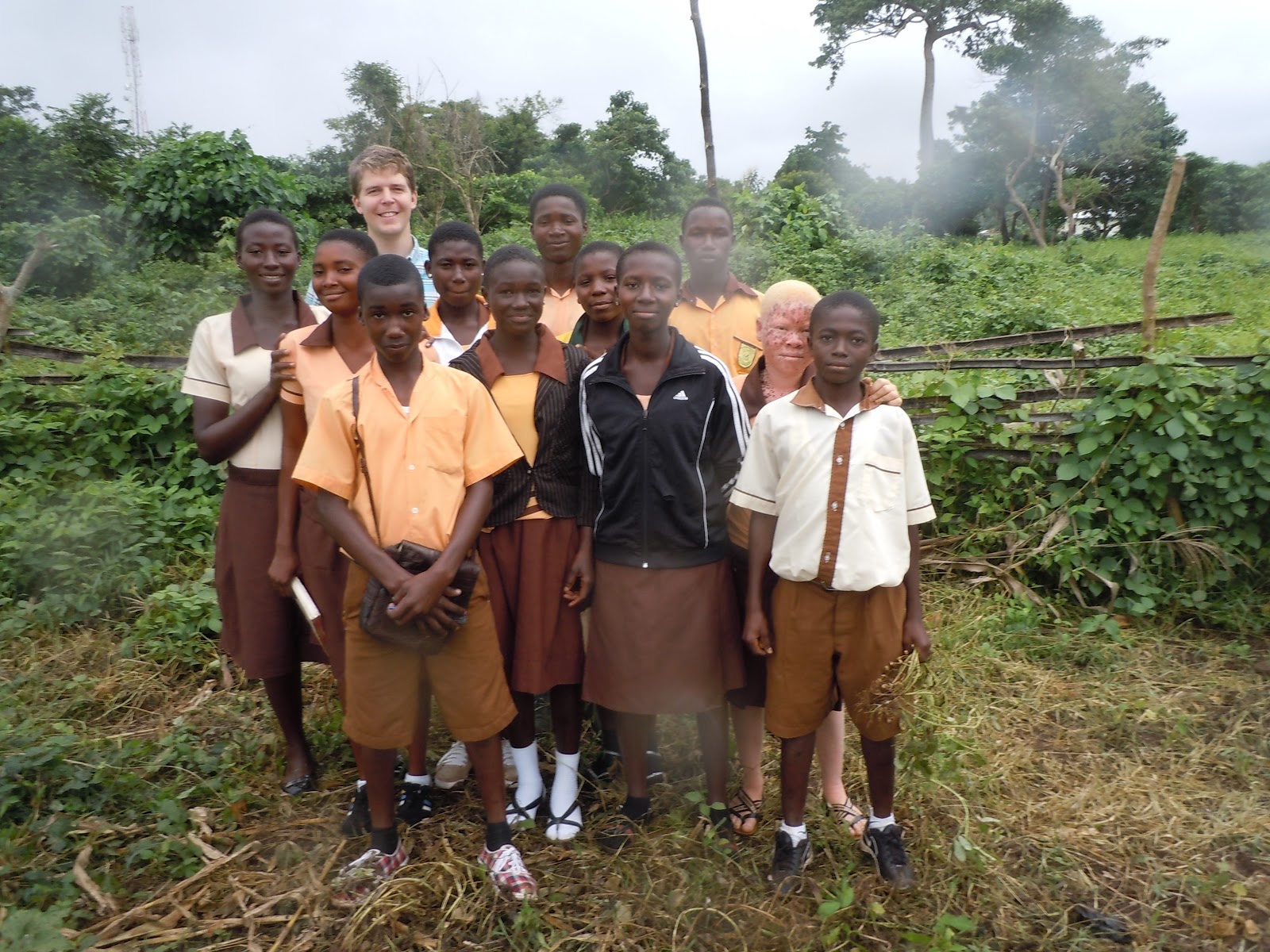
Today, Helena, Mike, and Clayton went to teach some science lessons at the school in Babianeha near Emmanuel’s family’s house.  The students we were teaching were junior high-aged kids, and we had a class of about 40-50 Form 3 students (similar to 8th grade). First, we met with the headmaster, Watuza, to explain what we were interested in doing with the students. Since both we and the headmaster want to have the students carry out a biochar garden experiment (where they will measure the growth of plants with and without biochar in the soil in order to see the effects biochar should have on increasing crop yield), our plan was to start them with a lesson on the scientific method, and then we would have them discuss the different aspects of the experiment in groups in order to develop their experimental plan.  After Helena gave a brief explanation on how to form a hypothesis, how to determine variables, and how to measure and observe data, Watuza divided the class into three groups (with Mike, Clayton, and Helena each leading one group) and we headed out to the garden plot that the school had fenced in for the students’ use.

Explaining how to set up an experiment

The teaching method in Ghana is mostly a lecture and memorization style where the answer to a question is just regurgitated, so during the classroom lesson, the students seemed to have difficulty understanding what were trying to tell them; much of the time they couldn’t answer quiz questions without looking at their notes, and our American accents didn’t do anything to help them understand either.  However once we got out to the garden and began asking them how they would plan their experimental garden, they were bursting with ideas about weeding, crop variety, planting etc.  They clearly knew a lot about growing and farming, a lot more than any of us did. 

We all had a lot of fun interacting with the students in our respective groups. Clayton had a little bit of a smaller group and tried to make a game out remembering all of their names, some of which were easy (one kid went by the memorable nickname “Noble Rasta”) and some of which were a little harder to say right (Adymaya). In Mike’s group, his students offered him a red pepper to eat. It was lucky that Mike declined the offer, though, because the students then told him that this pepper was so strong, that if he ate it, it would make his throat swell up. Helena was amused by her group when they got into a heated five-minute argument about whether or not it was possible to count all the okras on an okra plant, and how some students would help her out by keeping the rowdier ones in line.


Clayton's group

Helena's group

Mike's group

At the end of the discussion session, all the students wanted pictures with us, so we obliged. Watuza wrapped up by letting us know that the garden would be cleared and prepared in a few weeks’ time in order to start the garden, and that they would also like us to come back sometime so we could be there when they make biochar in the community. We said we would do our best, and then as a parting gift, we gave the junior high a digital camera with which they could take pictures to further document their garden.

We then stuck around the school another hour or so to do science demonstrations with the other classes at the junior high, and Clayton and Mike did a great job explaining and demonstrating how molecular interactions allow a skewer to be poked through a balloon without popping it. This demonstration was made difficult though, by the fact that Ghanaian balloons appear to be a bit different in material from American ones, but we were still able to get the demonstration to work, and the students enjoyed it. Lastly, we were led into some other classrooms just to say hi to a few groups of students who had been displaced from their regular school building due to damage from a storm.
Clayton and Mike demonstrating some polymer science

It was then time for us to travel back to Sunyani to meet up with Chelsea and Mollie. We waited at the taxi station in Babianeha for a while (the taxis don’t leave until there are enough people to fill them) before riding to Dormaa, where we had a pleasant journey on the bus ride to Sunyani. A group of school kids snuck up and sat by us on the bus, giggling about having had the nerve to come sit next to the obronis (white people/foreigners). We had some fun conversation with them about snow, each others’ names, and whether the trees in Michigan have leaves like they do here in Ghana.

When we arrived in Sunyani, Clayton, Helena, and Mike joined Chelsea to meet with Dr. Jacob Abrebese, the Medical Director of Sunyani Regional Hospital as well as an assemblyman for the village of Nsawkaw.  Dr. Jacob, or Jacob, as he insists on being called, has been extremely instrumental to groups in the past and his ideas and interest in the Pavlis program are as strong as ever.  Some of the first words out of his mouth upon introduction to our group were an emphatic, “When will you come to our village?” Chelsea explained to him the efforts we made to collect information in order to ship re-purposed medical equipment to the Tain (pronounced Tine) District Hospital throughout the past fall and spring semesters.  However, due to an inability to sustain adequate communication with our medical contact there, efforts were put on hold until further communication could be achieved. 

In discussing the proposed project with Jacob, however, it became very clear that the Nsawkaw community would be perhaps more interested in a joint shipment of supplies involving collaboration between their education and health boards.  That is, while they think medical equipment may serve good purpose, books and educational (especially related to Information, Communication, and Technology—or ICT, as they commonly refer to it) support are of equal or greater need.  Jacob insisted that the time to act should be soon, as upcoming political elections may drive politician financial support in shipping items.  Further, he was especially intent on Pavlis having more direct interaction (i.e. doing lessons in schools, etc) with the community.  While we were unsure to what end we would be able to facilitate Jacob’s high hopes (as from here on out, our schedule was filling up pretty quickly), we did already have plans to visit Nsawkaw on the upcoming weekend to get a better idea of how future Pavlis cohorts can have a positive impact there. 


*Note: This post was written by Clayton, Helena, and Chelsea

Monday, July 9, 2012

Biochar, Laundry, and Butterfly Sanctuary – July 6


Thanks to our many friends and advisors, our days in Ghana so far have been going very well. This morning, we visited the Soil Research Institute (SRI) in Kumasi, where some of the most extensive research on biochar in the world has been done. Biochar is a substance which is produced by charring organic matter in an anaerobic environment. It has many benefits, particularly the fact that it significantly increases crop yields when put into the soil. Therefore, Ghanaian biochar scientists are trying to increase biochar usage in agriculture. Last year’s Pavlis group started helping with the education side of this effort by talking to rural farmers about the benefits of biochar (which are not yet widely known by the general public) and organizing a small garden biochar experiment for school children in the village of Babianeha.

We plan on continuing the school garden experiments at various locations, but we wanted to meet with SRI to find out how else we could support the efforts of the biochar researchers. We met with Dr. Edward Calys, who generously took the time out of his busy schedule to sit with us and explain the current state of biochar usage in Ghana. He was very passionate and proud about the progress that has been made in recent years. So far, Ghana is putting one biochar reactor in each region of the country, which is far ahead of most countries in the world. However, this number of reactors is still not enough to allow farmers in rural areas the opportunity to use biochar.

Dr. Calys told us that what he needs most is more resources and help with improving the technology of their biochar reactors. So, we proposed to him the idea of starting an international senior design project for engineering students at Michigan Tech, whose aim would be to improve the reactor design. We gave him the appropriate paperwork to fill out, and hope to hear back from him soon.

Next, Dr. Calys introduced us to a director at SRI, as well as Dr. Edward Yeboah, the head biochar researcher. Both of them were very kind and welcomed us to the area. We then got to see some biochar for ourselves, since one of our great FORIG drivers, Godwin, was bringing some back for Emmanuel’s research. Dr. Calys also made arrangements for us to visit the nearest biochar reactor when we come back to Kumasi in a few weeks.

Dr. Calys on left showing us biochar
We then drove back to the FORIG campus, where Mollie, Chelsea, and Helena went to eat at the canteen while Mike and Clayton went into town with our other FORIG driver and pal, Govina, to get fitted for some Ghanaian shirts. At the canteen, which is a nice, open air restaurant of sorts for students and staff, the girls had some rice and veggies, along with a new soft drink we have discovered, called Alvaro. After finishing our meal, we met a student from the civil engineering department at KNUST who got very excited when he found out that we were from Michigan (he said he had read travel guides about Michigan) and sat at our table to find out about what we were doing in Ghana. We were very impressed that he finished an entire plate of banku (a dense sour dough made from cassava and maize) and soup during the course of our conversation; most of us usually have some trouble finishing our food here because it is so filling.

After lunch, Mollie, Chelsea, and Helena went to visit Naomi, the woman from the marketing department at FORIG who has been helping us with the advertising for the Duasidan Monkey Sanctuary. We gave her a draft of an info brochure for the sanctuary, and she generously told us she would work on designing a brochure (called flyers here in Ghana), road sign, and info poster over the weekend. We still need some information to complete these documents, but this coming week we hope to visit Duasidan again to get the input of the villagers and wrap up our lingering questions.

The girls then went to Emmanuel’s house to do some laundry- the Ghanaian way. We learned how to wash our clothes by hand using several buckets of water for washing and rinsing. We were accompanied by some of Emmanuel’s children, who actually took some time out from playing in the yard every once in a while to help us with some of the clothes washing.

Laundry with some help from small hands
Meanwhile, Mike and Clayton were shopping for essentials in the Central Kumasi Market, after getting fitted for their shirts. They were able to get a view of the entire market (largest one in West Africa!), which spans a huge area at their tailor. They made it back to Emmanuel’s house just in time to learn how to do some laundry themselves, and then we all squeezed into Govina’s truck to drive a half-hour outside of Kumasi to the guesthouse at the Bobori Butterfly Sanctuary, where we planned to stay the night.

Driving with Govina (who has driven us many places over the past few days) has been a lot of fun, and we have become familiar with quite a few hip new Ghanaian/African songs during the long drives. It was dark when we arrived at Bobori, but we could already see how great this location was. It was about a ten-minute drive through the forest to get there, but the guesthouse was very nice, with beautiful forest-murals painted on the bedroom walls, a well-equipped kitchen, and even a “room for relaxing”, which consisted of an outdoor patio with chairs and a table. Before the electricity was scheduled to be turned off at 9pm, we had time to make ourselves some spaghetti with vegetables (including a tomato-sized type of white eggplant the guys had gotten from the market earlier in the day), and enjoy the “room for relaxing” before turning in for the night.