Showing posts with label Duasidan. Show all posts

Sunday, August 5, 2012

Last Trip to the West – July 31


We started the day early with a 6:30 departure for Kwame Yebohakrom in one of the FORIG trucks, with what we hoped would be the last of the parts for the Lister engine project. With Govina at the wheel of the truck and Peter as co-captain we made quick time to the village arriving somewhere after 10, even with a quick stop for fufuo. The building for the engine was still unfinished but was complete enough to hopefully finish the project. After quickly bolting the generator up, tightening the belt in place we were ready to test our system. The engine was fired up, running as well as ever and the generator was spinning without vibrating out of place or throwing the belt. Everything seemed okay until Peter went to test the generators voltage with a standard light bulb, which was immediately popped. Concerned, we called the man we had purchased the generator from to learn that he misspoke when we told us the generator operating speed, and we were operating it at over twice what it should be running.

A man in Duasidan next to the covered Lister engine
Determined to finish the project, we decided after a bit of head scratching to try the second smaller pulley on the machine that was shipped with it to see if we could match the desired speed.  After a quick run to Nkran Kwanta to grab another belt and relocating the generator we fired the Lister engine up again for another test. Sadly, even though the generator was spinning at what should be the correct speed, the test light bulb was popped again. Even after turning the generator around to spin it in the opposite direction we were unable to get the correct voltage. Running out of time in the day, we decided to take the generator back to Kumasi to see if it had become damaged on its way to the project site. It was upsetting to leave the village with all our hard work unfinished, but we knew if the generator could be revived, our friend Peter would have no problem finishing the project after our departure.

Meanwhile the girls were dropped off at Duasidan in the morning to have one last meeting with community members regarding the monkey sanctuary advertisements and future work in the community.  We arranged with the printer in Kumasi for the road sign advertisements to be printed before our departure from Ghana and arranged for the Duasidan Assemblyman, Jacob, to post them at appropriate intersections en route to Duasidan.  The community expressed interest in forming a community center if future Pavlis students could provide supplies for it.  They even showed us which room in an old school building they could renovate for community use. 

After our formal meeting we requested that we could have a taxi called to pick us up.  It took three hours to actually get the taxi, but we passed the time playing with the huge crowd of kids that showed up.  Finally, the taxi arrived, driven by a nice guy called German, who dropped us off in Babianeha. 

Mollie and Helena with kids in Duasidan
In Babianeha, Mollie went with Victoria, Emmanuel’s cousin who will start University in September, to interview families in the village about their cooking habits.  It was really interesting to see the range of cooking methods used in the village all the way from very modern gas ranges in kitchens to open fires outside the house.  Meanwhile, Helena and Chelsea ran a few final errands around town, including dropping off a bag of biochar for the school garden. 

A typical outdoor fire for cooking
In the afternoon the girls traveled to Dormaa to speak with the MCE there.  However, because it was the one-week celebration of the president’s death, both the MCE and the Director were busy and so we got to meet the assistant director.  He was very enthusiastic about our efforts to advertize the Duasidan Monkey Sanctuary and he was especially excited about the website we hope to develop.  He was very optimistic about future development of the site by the Dormaa Assembly in collaboration with Pavlis!

After a long day of work everyone was ready to head home to Sunyani to have dinner with a delegation of people from the Sunyani MCE’s office as well as some other friends from Sunyani.  Just as Mike and Clayton were beginning to arrive in Dormaa to pick up the girls, their truck overheated, stalling on the road. The girls were sent on ahead to finish the journey by bus, just before realizing that Mike and Clayton had the only sets of keys to the dorm. Running quite a bit behind, the truck was quickly fixed and the guys quickly rushed home to change with the waiting girls and head to the dinner.

Despite being one hour late, we were still able to meet everyone for a wonderful dinner. The meal was a fancy buffet with two courses.  We all looked quite dashing in our newly tailored Ghanaian outfits if we do say so ourselves! 
The group with our friend Govina after the dinner (note his black clothing and red scarf worn in honor of the one week celebration of the president's death) 
Written by Mollie and Mike

Monday, July 30, 2012

Duasidan with a bit of Babianeha - July 14 and 15

When the girls’ second morning in Babianeha dawned, the Opuni household had once again prepared us a generous breakfast. Mollie wasn’t feeling too well that morning though, so to be safe, Chelsea and Helena (as well as our friend Lawrence from the Opuni house) accompanied her to the hospital in Dormaa in the afternoon. They just missed Clayton and Mike, who arrived in Babianeha shortly after the girls left, so unfortunately we weren’t able to be reunited that day.

On Sunday the 15th, Mollie was doing fine, but Chelsea and Emmanuel went with her to the hospital in Sunyani where she could be more comfortable. Meanwhile, Helena, Mike, and Clayton went to the village of Duasidan to talk to the community about the monkey sanctuary. Kwadwo, one of Emmanuel’s brothers and the assembly man for Babianeha, had contacted Jacob Obiri, the assembly man at Duasidan, to set up this meeting for us. We had actually been expecting to just meet with a handful of people, but when we arrived, we were ushered into a courtyard where about thirty community members sat all the way around the square. Formalities in Ghana are all about hand-shaking, so we shook all their hands, and vice versa. Then we (along with Kwadwo, who translated for us) sat on the elevated side of the courtyard, and our discussion with the community could begin.

First, we explained our purpose for being in Duasidan: to help further the mission of the monkey sanctuary, that is, to promote the protection of this habitat for the monkeys and the biodiversity of both the plants and animals in the area. We would like to help by providing the community with resources for advertisement, but we need the community’s opinions and input. We showed the community members the draft of the brochure for the sanctuary, which had been designed by the marketing department at FORIG. Everyone around the room was nodding in satisfaction as they saw the design, and seemed to agree with our idea of distributing the brochures to hotels and other locations in Sunyani, as well as keeping copies at the visitor’s office. We also explained that we planned to design a poster for the visitor’s office, as well as a few road signs to be posted at convenient intersections near Duasidan. The community gave us a few suggestions for places where the signs should be located.

We then established that Jacob, the Duasidan assembly man, would be the English-speaking phone contact for the sanctuary, and the community also decided on which days of the week and during what hours the sanctuary would be open for tours. Our entire interaction with the community was very interesting for us, because we would start by telling Kwadwo what we wanted to ask, then Kwadwo would approximately translate our question for the community, and then the community members would debate heatedly, back and forth, for up to ten minutes, and then Kwadwo would again translate the verdict for us. People were especially passionate about the question of what the open hours for the sanctuary would be, since they are a farming community, so it is important to work around the schedule of the sanctuary guides who farm to earn a living. The discussions were interesting in that people would always say times and numbers in English, but the rest would be in Twi. So we would hear “somethingsomething 10am somethingsomething” and so on. Needless to say, it was a great experience to be able to sit in on this community meeting which was so different from how these things work in our hometowns.

Eventually, the community was hesitant to discuss more, due to the fact that the Duasidan chief (who actually resides in Dormaa) was not yet aware of our presence, so we said we would make plans to contact the chief and come back another day in the coming weeks to wrap up our questions for the community. We also needed to get information from the chief about the history of the monkeys in Duasidan, because the chief has a document, which details a study done by the Ghana Forestry Commission about ten years ago, which has the monkeys’ history in written form (so far we have only heard it orally, so we want to make sure we have a consistent story before it is printed in the brochures).

As the meeting wrapped up, we asked the community if they had any other needs they wanted to address. The main issue which came up centered around education. Like many rural communities, Duasidan schools lack books, computers, and other resources for students as well as the greater community. The community members expressed interest in next year’s Pavlis students working with Duasidan to bring in supplies for a community center, similar to how Pavlis worked with the community in Babianeha two years ago. At the very end of the discussion, the lone woman in the room stood up to say that if possible, we should return to Duasidan before school lets out on July 26, so that we can visit the school and meet the students. We said we would certainly try, and with that, the meeting ended with us going around and shaking hands with everyone twice (again), and then we rode back to Babianeha. The driver who drove us and Kwadwo was a very assertive driver who sure got going pretty fast down those dirt roads!

When Helena, Mike, and Clayton got back to the Opuni house, dinner was waiting for us, and we happily dug in. We were also able to check in (over the phone) with Mollie and Chelsea (who were in Sunyani by evening) before turning in for the night.

(Written by Helena)

Saturday, July 7, 2012

Journey – Akwantuo: July 2,3


On our second day in Ghana we were introduced to Sunyani, a city approximately two to three driving hours west of Kumasi.  We settled into rooms at the city’s KNUST satellite dormitory; we will use these rooms as a housing base throughout the rest of our stay in Ghana.  We spent most of the day running errands (i.e. securing plane tickets for our advisor’s departure, exchanging our US dollars for Ghanaian currency, the cedi, and outfitting our new residence with common household items such as hand soap and dish detergent.  On our trip to the Sunyani market, we stocked some of our in-country phones with minutes and we were even able to try a popular local snack, pies (meat and onion filled bread, a seemingly distant relative of the pasty!).  We ended the evening with an even more familiar dinner (pizza!) with our advisors at their local lodging, the Eusbett Hotel.

Beginning the next morning, we had a very full day of traveling around with our advisors.  We were off just after 7 am and on the road to Dormaa, just outside of Sunyani.  The road has many speed bumps/rumble strips with two or three small strips in the road in a row.  After meeting briefly with a representative for the regional minister, we continued on to Kwame Yeboah Krom (Kwame is a common first name, Yeboah is a common last name and Krom means village.) To put it mildly, the road was extremely rough on the way to the village. 

We met a local government representative near Kwame Yeboah Krom and he lead us into the village, where we were visiting the Lister engine, a simple engine that was ordered for the village two years ago and just arrived a few months ago.  Our goal for this trip is to facilitate the building of a housing structure for the engine, to buy a generator, and to try to get the engine up and running.  It was very exciting to practice our small Twi phrases, as most people in the village didn’t speak English.  The kids especially got excited! This was our first time visiting a more rural area, and we had an enjoyable, if short, time.
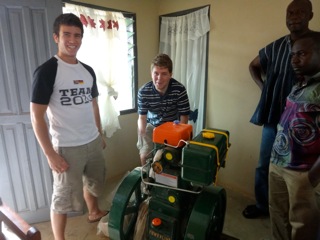
Mike and Clayton checking out the Lister engine           
After visiting the engine, we visited the local representative’s home in the neighboring village of Okirakrom.  When we visit again to work on the engine for a few days, we can stay at his house.  In the courtyard there were a bunch of orange trees that were heavy with fruit.  In Ghana, oranges are green on the outside, but orange and juicy on the inside.  What a treat!

From there, we continued on to the village of Duasidan to visit the Duasidan Monkey Sanctuary, a relatively unknown location that the locals would like to develop into an ecotourism site.  Here, a large group of kids flocked with us and our two guides a short way into the 40-acre plot of forest.  In a clearing of bamboo, one guide started tapping on the sticks and pretty soon, we were surrounded by monkeys!  We had brought peanuts and small bananas to feed to them and they snatched them right from our hands!  One of our projects is to help advertise the sanctuary to tourists, so we took a lot of photos and videos.  Emmanuel sat down with our two guides to help translate and we taped an interview with them. 
The group with two local guides (left and second from left) and one of our divers, Govina (third from left)

Monkeys!

Chelsea feeding a Monkey

Next, we traveled about 20 minutes to Babianeha, where Emmanuel’s family is from.  Emmanuel’s mother had prepared a huge and delicious lunch of chicken, a cocoyam leaf (like spinach) dish, and jollof rice for us! After a quick meal, we visited the community center that was founded by Pavlis students in the past, interacted with the children who were there reading books and using the laptop computers, and then took a short walk to the Ghana/Ivory Coast border.  We talked to the border officers and then crossed over briefly.  It was pretty much the same as being in Ghana except for a few French phrases.

After our short visit to the Ivory Coast, we headed back into the vehicles for the long drive back to Kumasi.  We finally got in around 8 pm, settled into a guesthouse for temporary lodging in the city, and then concluded the evening for dinner with our advisors at the Royal Basin Hotel.