Showing posts with label death. Show all posts

Sunday, August 5, 2012

Accra and Goodbye Ghana – August 3


We wanted to make a few last touristy stops around Accra to see the important monuments and other miscellaneous places that we hadn’t seen, since we had only been in the city for a few hours on the day we first arrived in Ghana.

Our first visit was to the tomb of the first President of Ghana, Kwame Nkrumah who declared Ghanaian independence in 1957.  His tomb was a large marble enclosure, Designed by a Ghanaian architect, constructed by the Chinese, with marble from Italy.  It was shaped like a sort of tree trunk with all of the outside walls curving upwards.  A nearby guide told us that the tree shape had been cut off to represent works unfinished by the President, whose government was overthrown by a military coup.  Later, driving by the very large Flagstaff House estate where the current President’s of Ghana always live, we could see that the massive Presidential Palace was also designed similarly.  In front of the tomb, pointing inland towards Ghana, was a large statue of Nkrumah, supposedly on the exact spot where he stood to declare the independence of Ghana.  Seven other statues of horn blowers on each side, as well as one statue playing native drums and one playing a native string instrument to represent the North and the South cultures of Ghana flanked the statue.

The Tomb
A horn blower
The Presidential Residence
After visiting the tomb we took a quick tour through the Kwame Nkrumah Museum nearby, which housed many photographs of him with famous figures like, Queen Elizabeth, Fidel Castro, Chairman Mao, and President Kennedy.  They had others artifacts too, like pens or desks corresponding with some significant time in his life.

The next visit was to the large indoor art and Ghanaian wares market at the Cultural Center not far away.  It reminded us particularly of a less overwhelming and smaller Central Market of Kumasi, but the whole thing had a roof over it.  We had a chance to pick up any last minute souvenirs and gifts that we had missed from the rest of our time here.  Most of the market contained what we’d seen all over, like masks, jerseys, cloth, kente, all concentrated in area (and for higher prices too).

Our final stop in Accra was the Mall, a place that was eerily American.  We ate in the food court to provide a variety of options, both Ghanaian and American.  Here we were also able to print off a photo of us with Emmanuel to put into the frame that we all signed for him as a thank you for all his work with us!  After picking up our things from the guesthouse, we headed straight to the airport to check our bags in.  That gave us a brief time outside to say our goodbyes to our friends Emmanuel, Govina, Cornelia, and Baba.  The international terminal in Accra is very nice and we had a good time swapping photos as we waited at our terminal, but all too soon the time came to say goodbye to Ghana and to say goodbye to Helena, who took a flight to visit family in Austria before returning to the US. 

Down to just four, we safely boarded our flight around 9 PM Ghana time and started our journey home!

Written by Clayton and Mollie

Kwame Yeboahkrom and the Death of a President– July 24th 2012

After another few trips into the magazines of Kumasi, the welding and parts for the generator set-up had all been completed and found for the lister engine project in Kwame Yeboahkrom.  Our caravan started with Mike and Chelsea returning from Kumasi along with Govina and Peter in a truck full of everything we were bringing.  Then at Sunyani Clayton switched in with Mike and headed out towards Dormaa and the village areas; Helena and Chelsea tro-troed their way there separately. 
            While we were riding in the truck, Govina began to hear rumors from his friends that something had happened to the President.  It turned out the President of Ghana, Atta Mills, had died in office.  We were told that rumors of his death were not uncommon since his health has been bad in recent years, but this time the rumor was true.  It’s a particularly strange time for such an unfortunate thing to happen because he was campaigning for reelection in the Ghanaian Presidential vote this December.  Now his VP, John Mahama, has been sworn in and will continue the elections.  Many people are wearing the red and black funeral cloth during the day, and the newspapers tell us there is a period of national mourning that will now extend until the late President’s funeral on August 10th. 
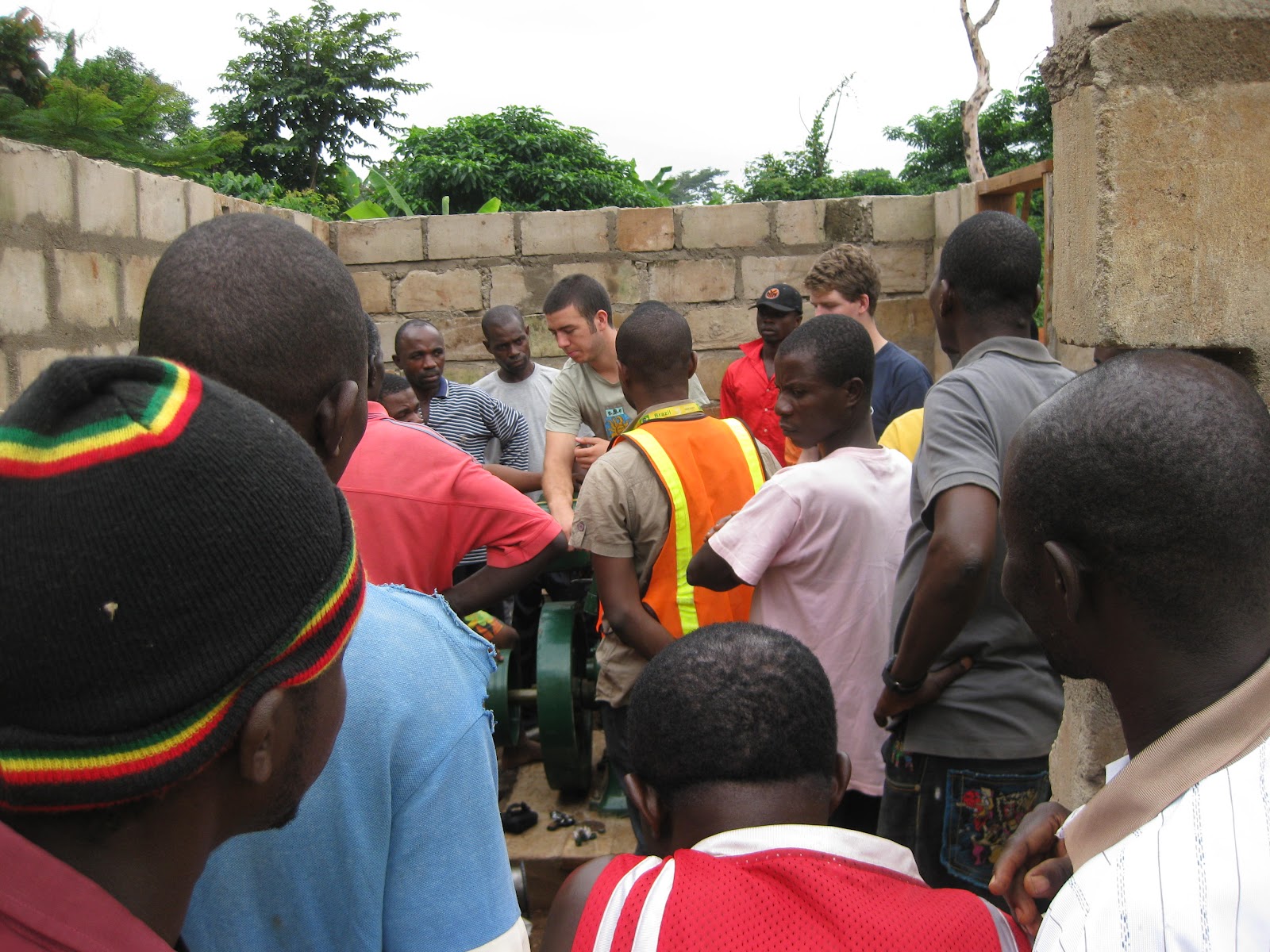
Going back to our village trip, we arrived at the village and we could see the small building they had constructed to house the lister engine.  They showed us inside we could see the villagers had already poured a concrete base and mounted the engine in position on top of it.  By luck there was a man in the nearby town of Ankrankwanta who had years of experience working with the kind of engine similar to ours, and he was a great assistance.  With a fresh can of diesel, motor oil and a little bit of cranking, the lister engine originally ordered by a previous Pavlis group started chugging happily away.
Most of the rest of our work was letting Peter set up the wiring and breakers to deliver power across the yard to the clinic, and setting up and mounting the generators itself.  We spent a while trying to communicate how we wanted the generator placed in relation to the engine, where the studs needed to be to secure it, how to align the belt, etc.  Nearly 20 members of the village surrounded us whenever we worked around the engine, and there was a lot of discussion in Twi we couldn’t catch over the plans we suggested.  Even the local village chief, Nana Yeboah, was into the discussion, and once we had established the spot for the generator and they began to pour the concrete, he was right down with everyone working and getting his hands dirty.
Mike working on the engine with an audience
Unfortunately one thing that went wrong was that the coolant system Mike had envisioned did not fit to the lister engine, and so we will just need to find a few parts in Kumasi and then return again for a day trip to set it up.  The concrete for the base did not dry during our stay, and so we also need to return to actually test the generator.                       
Our plan was to stay two nights in the Kwame Yeboahkrom and leave on the third day, so we stayed inside the spare rooms of the clinic that were kindly offered to us.  During the night of the President’s death we were invited into the downtown area of the village to have dinner at the chief’s house.  It was fascinating to actually be staying in one of the more remote villages in Ghana and seeing a little bit more of what life was like day and night.  Outside the chief’s house we waited for a while under a solar-powered street lamp and a good number of the village residents came and gathered around the area to take a look at us.  The children got a big kick out of our attempts at Twi and many of the older villagers were fascinated by Helena and Chelsea’s hair.  After the dinner of rice and hard-boiled eggs with spicy tomato sauce, the village had a small funeral celebration dance in honor of the late President Mills.  Govina was still with us, and pushed us to lead the dancing.  The music was loud and a lot of people showed up to join or just watch the obroni trying dance the popular Azonto dance.
The following morning before we got to work, Nana Yeboah showed us around his village.  The first day he showed us a cocoa plantation, and we learned that the majority of the people of Kwame Yeboahkrom are cocoa farmers.  We had never seen anything like the big yellow and green pods sticking out of the cocoa tree trunks, and later Nana invited us to try some of the dried beans from the pods that tasted exactly like unsweetened chocolate.  The next morning he showed us the palm farms, where the trees were either cut down and tapped to harvest the sweet and tangy sap, or left standing to produce palm fruit, then processed into palm oil, an extremely popular cooking oil in Ghana.

Dried cocoa beans and two picked cocoa pods pictured
Written by Clayton

Tuesday, July 24, 2012

The President Dies

This week I am staying with our contact, Emmanuel, and his family, at
their house in Kumasi. This afternoon, I was reading in the living
room after the kids returned from school when Godwin, one of the
Emmanuel's students, brought the news on the radio to my attention:
The President of Ghana, Prof. John Evans Atta Mills, had just died.

This came as a huge shock to me and the rest of the country as he had
just celebrated his 68th birthday on Saturday. The news is reporting
that he was taken to the hospital a few hours before his death. An
emergency session of parliament was called to swear in the vice
president, John Dramani Mahama at 8 PM. Mahama had just returned from
the US on tour for his new book a memoir.

The TV and radio have had nonstop commemoration and reaction
interviews. Mills was apparently a huge sportsman, and accordingly
the football (soccer) final scheduled for this weekend has been
postponed out of respect. There has been an outpouring of condolences
from every interviewee for his family. The mood is very somber.

At 8 PM I joined the whole family in front of the television to watch
the ceremony, with many of the parliament members sporting red and
black strips of cloth tied around their arms, necks and heads - the
traditional funeral colors of Ghana. The session began with prayer,
then a minute of standing in silence in honor of the late president.
A band played the national anthem and the vice president was summoned
to repeat his oath of office. After his completion, he was directed
to sit in the president's high seat at the front and center of the
parliament. As he sat, he was greeted by applause, but subsequently
rose to address the country.

He declared a week of mourning for the country, including flags at
half-mast, then went on to lament the loss of a father, colleague and
mentor. I can't even imagine the shock and burden he feels at this
time. After his speech the majority leader moved to close the session
with no other business and the motion was seconded by the minority
leader. With no objections, the session was closed and the band
played again.

We will see what this next week of mourning brings to our team in our
experience of Ghana. It certainly is an historic time to be here.

---

PS - Just to explain the delay in posting blog updates: I am in Kumasi
with the (mostly) working internet modem that has very little data on
it, while the rest of the team is working out of Sunyani with many
blog posts written but a very dysfunctional modem that should have
multitudes of data available, but seems to refuse to load blogger.
We'll keep trying!

Thursday, June 28, 2012

Cultural Expectations


We now have two days to go until our flight to Ghana! As we mentioned in our last post, we have spent the last six weeks preparing for our trip by learning a bit of the different aspects of Ghanaian culture. Previous Pavlis groups, as well as our TA Emmanuel spent a lot of time telling us about their own experiences. Here's a snippet of what we've learned!

Family
Relationships between family members are a lot closer than in the U.S., typically. One way this can be seen is in how relatives in Ghana are named; your father's brother, for instance, would not be referred to as your uncle, but as another father- and to suggest otherwise would be very disrespectful. The same idea would apply to your mother's sisters - they would also be called your mother. Likewise, all of your cousins would be considered your brothers and sisters. This is one reason why homelessness in Ghana was relatively rare until recently (that is, until greater urbanization and modernization began to set in), because extended families always provided support.
Our TA Emmanuel with his wife Ester and son Adom
Time
Ghanaians often jokingly refer to "Ghana Time"; not as a time zone, but as a way of life! They are typically much more relaxed in regards to punctuality, and it is not at all uncommon to show up two or three hours late to an appointment. So when a friend shows up late to lunch, there's no reason to be angry- just smile and laugh, and everything will work out the way it should.

Food
Ghanaian food boasts many kinds of soups, meat, starchy types of dough, and dishes utilizing the many fruits and vegetables available in Ghana. Some typical meals include: 

Fufu- a dough made from pounding plantains and cassava, usually eaten with soup 
Redred- a dish of fried plantains and oil from the palm tree fruit 
Kelewele- ripe plantain, hot pepper, and ginger 
Grasscutter- a type of large rodent, a specialty of Ghana's!
Banku- made of maize and cassava
Groundnut Soup- a peanut soup, usually served with meat as well
Jollof Rice- rice cooked with tomatoes and red pepper, among other ingredients

An example of a typical meal in Ghana [1]

Sugar is very uncommon in Ghanaian dishes, as are the use of ovens, so there are not many sweet or baked goods. Most meals are prepared on stovetop, and eaten with the fingers- yes, even the soups! ;)

Life and Death
Being married and having children are two of the most important values in Ghanaian society- so much so that when a Ghanaian meets you for the first time, instead of being asked "Do you have children?" you may be asked, "How many children do you have?" Many foreigners in Ghana will also tire of the frequent marriage proposals from strangers - some serious, some not! ;)

Also dissimilar to Western culture is Ghanaians' attitude towards the death of a loved one. Whereas American funerals are typically a solemn affair, funerals in Ghana are extravagant celebrations of life, with much food, singing, and dancing.

A funeral celebration in the Upper Volta Region of Ghana [2]

Social Life
Ghana has often been described as one of the friendliest places in the world- and probably deserves the title! While we have been warned to watch out for "professional friends" who make a living of scamming tourists, the majority of Ghanaians are genuinely eager to help out and meet new people. Of course, this doesn't mean that the sellers in the local market won't raise their prices as soon as an obruni (a white person) walks by, so we're practicing our bargaining Twi! 

Because social life is such an integral part of Ghanaian culture, greetings are also very important - if you do not greet someone when you meet them, they may believe you are holding a grudge against them. Also, left-handers beware; use of the left hand for shaking hands or even waving is considered an offensive gesture.


If you would like to learn more, we highly recommend the following books, which we read and enjoyed in our exploration of Ghanaian culture:

Utley, Ian.  Culture Smart!  Ghana.  New York:  Kuperard, 2009.
Wyss, Susi.  The Civilized World:  A Novel in Stories.  New York:  Holt Paperbacks, 2011.

The last two pictures in this post can be found at 
[1] Erose Blog <http://emmarose91.blogspot.com/2011/04/fufu-originated-from-ghana-where-it-is.html>  
[2] Chip Williams Photography <http://www.chipwilliams.com/#/travels/Ghana_Funeral_Dance>