Showing posts with label Nsawkaw. Show all posts

Sunday, August 5, 2012

Nsawkaw - July 22


Chelsea, Helena, and Mike were met in the morning by Godwin, one of the drivers from FORIG, who would accompany us on our trip to Nsawkaw. In Nsawkaw, we needed to visit the Tain District Hospital to discuss the needs of the hospital with Dr. Rockson, and if still applicable, to get the necessary information to arrange a shipment of repurposed medical equipment in the coming year. We also planned to visit the senior high school where last year’s group donated several netbook computers and other supplies.

Chelsea, Godwin, and Mike at the back of the tro-tro to Wenchi

Helena in the tro-tro to Wenchi

We had to take a few taxis to get to the right transit station in Sunyani from which we could take a tro-tro to the town of Wenchi, followed by another tro-tro to Nsawkaw. Tro-tro rides are always interesting- at one point, our tro-tro had overheated, so the driver just flipped up the front seats (where the engine was apparently just underneath) and poured water on the engine- filling the tro-tro with steam- until it was cooled enough. All the Ghanaians in the tro-tro turned to grin at us at that point, and said “Welcome to Africa!” At the transit stations, we were also on the lookout for Ghanaian donuts, which are a really common food sold on the streets here, and they normally consist of just a ball of deep-fried dough. At one of the stations though, Mike and Chelsea spied what looked like sugar-covered donuts, and we searched for them throughout the day after that, without success.

In Nsawkaw we were greeted by Mr. Brobi, a man who has worked with Pavlis in the past.  Mr. Brobi facilitated our day’s meetings at both the hospital and the school. First we went to his house, a nice place where future Pavlis students would be welcome to stay if they needed to be in the area multiple days. Then we visited the Tain District Hospital- a very nice place with a TV in the waiting area (a Chelsea soccer game was on while we were there) and several green courtyards. Most of the hallways were open-air. We were led to Dr. Rockson’s office, where we discussed the state of the hospital’s needs, previous obstacles to effective communication, and his (and the hospital’s) interest in working with MedWish, an organization that repurposes medical equipment for the hospital’s in need.
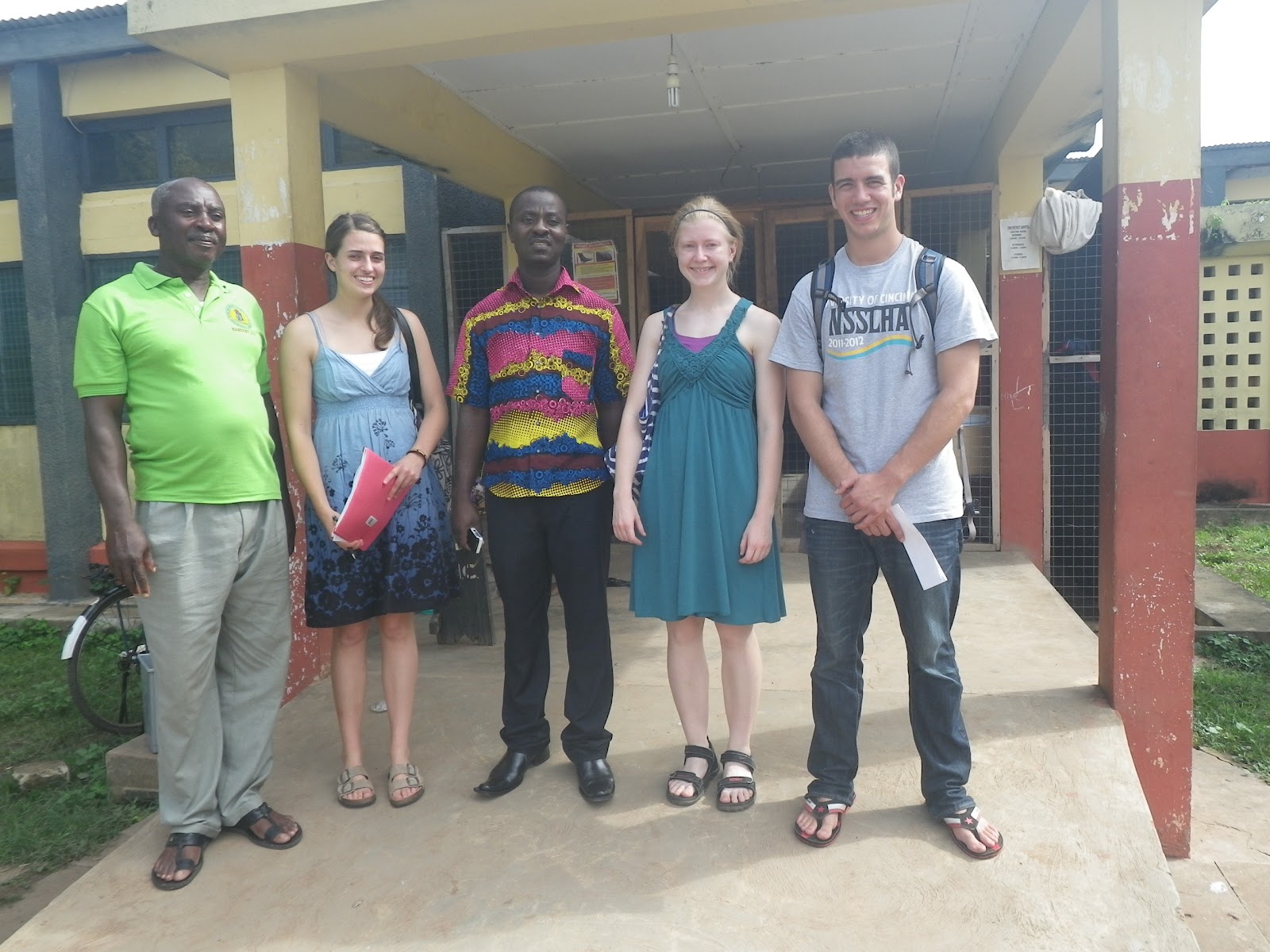
With Mr. Brobi (left) and Dr. Rockson (middle)

In order to better familiarize us with the needs of his workplace, Dr. Rockson then took us on a general tour of the hospital. We took several pictures and listened to Dr. Rockson’s explanation of the different areas of the hospital. Finally, we shook hands (as always) and left the hospital to walk to the senior high school to meet with the headmaster (we couldn’t see any students since it was a Sunday). We walked about fifteen minutes outside of town to a school surrounded by a huge open field. The classrooms were open-air, but the current, as well as the former, headmasters who greeted us ushered us into an enclosed room, where we discussed how the supplies they received last year are working for them, and what their other needs are.

They really appreciate the ten or so computers which Pavlis gave them last year, because they can use them to teach the students basic computer skills, which many students in Ghana can only learn theoretically because they don’t have the computers to try it out themselves. The books and other supplies were given to the students, and were also appreciated. The headmasters explained that the senior high has not only switched from being a private to a state-run school this year, but they will also soon be moving to a new building on the other side of town. What they would really like to have near the high school is a community center filled with more computers and books, and they would need whatever assistance they could get, not only with the supplies for filling the center, but with the building materials as well. We emphasized that although we will pass on this information to next year’s group, whether or not they can help will depend on their resources. We wrapped up the meeting by signing the school’s guestbook, and had the excitement of seeing the signatures from last year’s Pavlis students who visited.

The guestbook at the Nsawkaw High School

Finally, we walked back into town to make our way back to Sunyani, taxi and tro-tro style. The only hiccup was that our tro-tro in Wenchi had a broken headlight, so we had to wait a couple hours until it was ready to go. The driver was pretty fast though, so that made up for some time! ;)

Written by Helena and Chelsea

Thursday, August 2, 2012

Biochar at Babianeha and Meeting Dr. Jacob -July 16


Today, Helena, Mike, and Clayton went to teach some science lessons at the school in Babianeha near Emmanuel’s family’s house.  The students we were teaching were junior high-aged kids, and we had a class of about 40-50 Form 3 students (similar to 8th grade). First, we met with the headmaster, Watuza, to explain what we were interested in doing with the students. Since both we and the headmaster want to have the students carry out a biochar garden experiment (where they will measure the growth of plants with and without biochar in the soil in order to see the effects biochar should have on increasing crop yield), our plan was to start them with a lesson on the scientific method, and then we would have them discuss the different aspects of the experiment in groups in order to develop their experimental plan.  After Helena gave a brief explanation on how to form a hypothesis, how to determine variables, and how to measure and observe data, Watuza divided the class into three groups (with Mike, Clayton, and Helena each leading one group) and we headed out to the garden plot that the school had fenced in for the students’ use.

Explaining how to set up an experiment

The teaching method in Ghana is mostly a lecture and memorization style where the answer to a question is just regurgitated, so during the classroom lesson, the students seemed to have difficulty understanding what were trying to tell them; much of the time they couldn’t answer quiz questions without looking at their notes, and our American accents didn’t do anything to help them understand either.  However once we got out to the garden and began asking them how they would plan their experimental garden, they were bursting with ideas about weeding, crop variety, planting etc.  They clearly knew a lot about growing and farming, a lot more than any of us did. 

We all had a lot of fun interacting with the students in our respective groups. Clayton had a little bit of a smaller group and tried to make a game out remembering all of their names, some of which were easy (one kid went by the memorable nickname “Noble Rasta”) and some of which were a little harder to say right (Adymaya). In Mike’s group, his students offered him a red pepper to eat. It was lucky that Mike declined the offer, though, because the students then told him that this pepper was so strong, that if he ate it, it would make his throat swell up. Helena was amused by her group when they got into a heated five-minute argument about whether or not it was possible to count all the okras on an okra plant, and how some students would help her out by keeping the rowdier ones in line.


Clayton's group

Helena's group

Mike's group

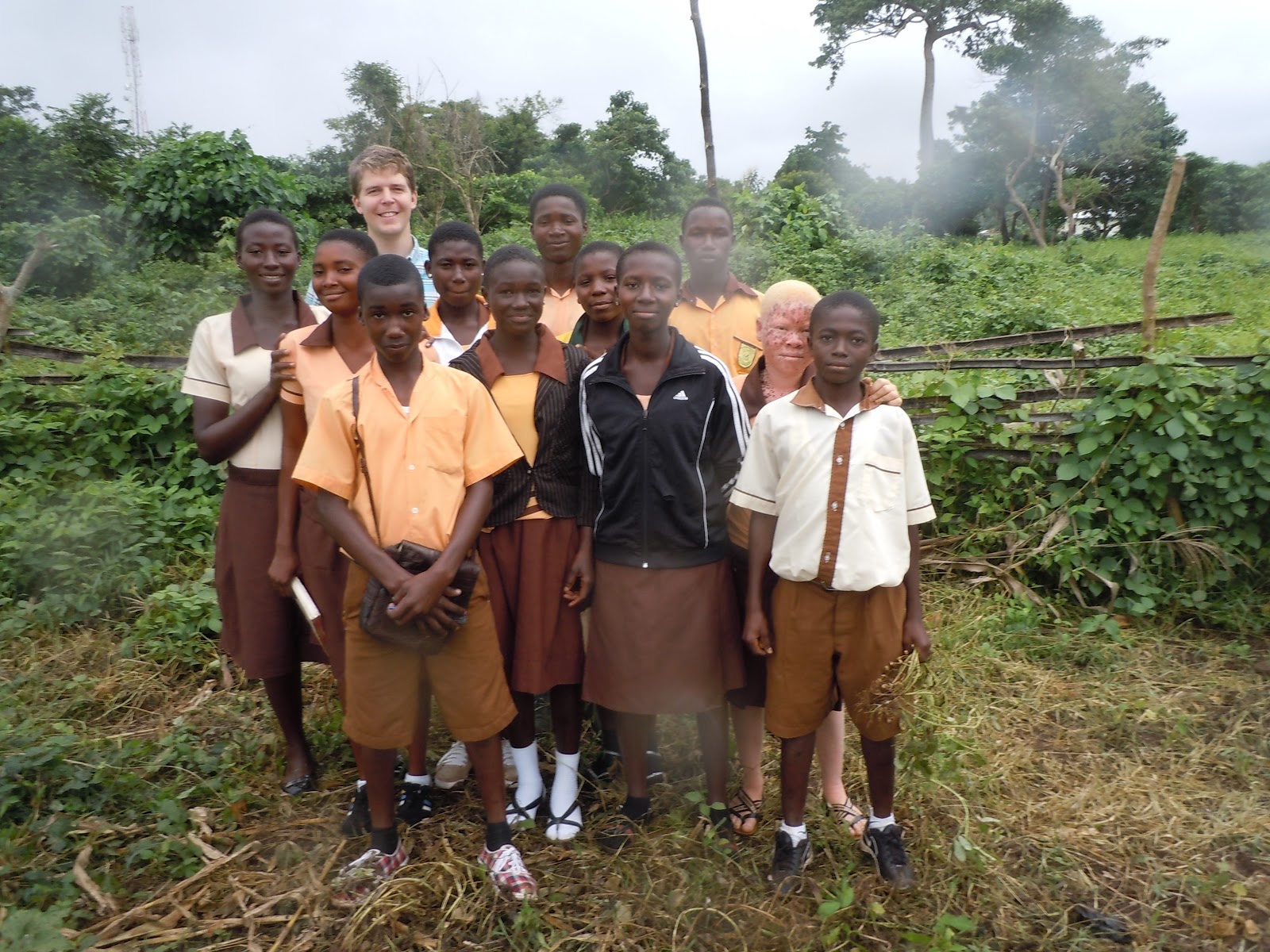
At the end of the discussion session, all the students wanted pictures with us, so we obliged. Watuza wrapped up by letting us know that the garden would be cleared and prepared in a few weeks’ time in order to start the garden, and that they would also like us to come back sometime so we could be there when they make biochar in the community. We said we would do our best, and then as a parting gift, we gave the junior high a digital camera with which they could take pictures to further document their garden.

We then stuck around the school another hour or so to do science demonstrations with the other classes at the junior high, and Clayton and Mike did a great job explaining and demonstrating how molecular interactions allow a skewer to be poked through a balloon without popping it. This demonstration was made difficult though, by the fact that Ghanaian balloons appear to be a bit different in material from American ones, but we were still able to get the demonstration to work, and the students enjoyed it. Lastly, we were led into some other classrooms just to say hi to a few groups of students who had been displaced from their regular school building due to damage from a storm.

Clayton and Mike demonstrating some polymer science

It was then time for us to travel back to Sunyani to meet up with Chelsea and Mollie. We waited at the taxi station in Babianeha for a while (the taxis don’t leave until there are enough people to fill them) before riding to Dormaa, where we had a pleasant journey on the bus ride to Sunyani. A group of school kids snuck up and sat by us on the bus, giggling about having had the nerve to come sit next to the obronis (white people/foreigners). We had some fun conversation with them about snow, each others’ names, and whether the trees in Michigan have leaves like they do here in Ghana.

When we arrived in Sunyani, Clayton, Helena, and Mike joined Chelsea to meet with Dr. Jacob Abrebese, the Medical Director of Sunyani Regional Hospital as well as an assemblyman for the village of Nsawkaw.  Dr. Jacob, or Jacob, as he insists on being called, has been extremely instrumental to groups in the past and his ideas and interest in the Pavlis program are as strong as ever.  Some of the first words out of his mouth upon introduction to our group were an emphatic, “When will you come to our village?” Chelsea explained to him the efforts we made to collect information in order to ship re-purposed medical equipment to the Tain (pronounced Tine) District Hospital throughout the past fall and spring semesters.  However, due to an inability to sustain adequate communication with our medical contact there, efforts were put on hold until further communication could be achieved. 

In discussing the proposed project with Jacob, however, it became very clear that the Nsawkaw community would be perhaps more interested in a joint shipment of supplies involving collaboration between their education and health boards.  That is, while they think medical equipment may serve good purpose, books and educational (especially related to Information, Communication, and Technology—or ICT, as they commonly refer to it) support are of equal or greater need.  Jacob insisted that the time to act should be soon, as upcoming political elections may drive politician financial support in shipping items.  Further, he was especially intent on Pavlis having more direct interaction (i.e. doing lessons in schools, etc) with the community.  While we were unsure to what end we would be able to facilitate Jacob’s high hopes (as from here on out, our schedule was filling up pretty quickly), we did already have plans to visit Nsawkaw on the upcoming weekend to get a better idea of how future Pavlis cohorts can have a positive impact there. 


*Note: This post was written by Clayton, Helena, and Chelsea