This morning Chelsea, Helena and Mollie woke up early and
enjoyed a wonderful breakfast of scrambled eggs and veggies with toast prepared
for us by Emmanuel’s family, specifically Lawrence, a very nice and helpful guy
around our age. After breakfast we
went to visit the junior high school, where they were in the middle of their
normal Friday worship.
The students were joyfully singing and dancing in the
classroom when we went to greet them.
The teacher asked us to say a few words to the class, so Helena told the
students how happy we were to hear their beautiful singing this morning, and
how we are looking forward to starting the biochar garden with them. The
students, however, just looked blankly at us, so the teacher repeated
everything that Helena had just said, because he realized that the students
simply hadn’t understood the American accent. We found out that we wouldn’t be
able to teach at the school that day, so we would have to come back on Monday
to do our biochar garden lesson.
The headmaster took us to see the bounteous garden that the
school maintains, full of onions, maize (corn), cabbage, okra, ripe hot
peppers, cowpeas, cocoyams, and more!
He plans to use the garden next year to teach about crop rotation and we
hope to also incorporate a section of the garden using biochar, to increase
yield. There is a sawmill next
door to the school where they can source sawdust to make into biochar.
Next, we visited the community center established by past
cohorts and assessed the state of the computers in use there. From there, we were accompanied by
Lawrence, Reagan, and Adinkra (all guys around our age) to the Cote d’Ivoire
border, where we walked along it for a ways, comparing the differences between each
country. Badukrum is the village
that is between the Ghana customs border and the Cote d’Ivoire customs border,
where the citizens have dual citizenship, share languages and currencies. We changed about 50 cents into sefa
coins, used in Cote d’Ivoire, as souvenirs. The Ghanaian street lights are poles with four cables strung
from each while the Ivorian lights are on cement posts with one cable on
each. There is a path past the
village that follows the border all the way north and south. We walked along it a ways and came
across some grave sites, sorted by religion.
After a mid-day nap we returned to the community center
where we met some kids and played a couple jumping games, including jump rope
with ropes donated by a previous Pavlis group, as well as a local jumping and
clapping game called ampe (pronounced ahm-pee). There we met Adinkra again and he led us to the one week
celebration of a man who had passed away in the village. In Ghana, funerals are quite
celebratory, but this was not the same as a proper funeral, for which they set
the date today for August 2.
At this ceremony, there was traditional drumming and
singing, accompanied by a couple traditional dancers at a time. When we arrived, we greeted everyone (including
all the chiefs and elders) in the first row of chairs then sat down to observe
the proceedings. After a short
time we were asked to dance, and with varying degrees of apprehension, we did
do our best imitation of the crouched, small steps of the other women we had
seen dancing. We were comforted by
the fact that we seemed to be well received and the gesture was appreciated. As we danced, three women gave us their
red and black shawls to wear, as these are the traditional colors of death in
Ghana and we were not dressed accordingly (as we had not known we would be
going to a funeral).
 |
| Traditional musicians and dancing |
When we finished dancing, we returned the shawls and sat
down again to soak in the call and response singing, the different percussion
instruments and the more expert dancing of the local women. After a time we were invited into the
neighboring house for a drink and were offered some pop, which we accepted, as
well as traditional palm wine, which we all tasted. The palm wine was sweet and served traditionally in dried
gourds. The men that drank the
wine poured the top off of the very top of the wine onto the ground to share
with the ancestors. Adinkra told
us that a practical reason for this is to avoid the impurities that float to
the top. After finishing our
drinks we returned and continued watching the celebrations until the ceremony
ended.
Upon returning to our hosts’ (the Opunis) house, we were
greeted with a dinner of rice, cocoyam leaves, chicken and spicy fish
sauce. After dinner, we rested and
watched some kids playing football (soccer).
---
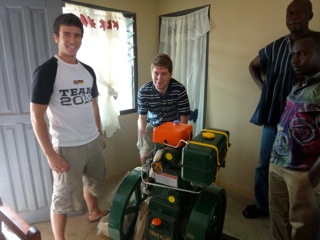
Meanwhile, Mike and Clayton started the day early and met
Peter at 8am to grab a tro-tro into town (Kumasi) where he knew some places that had
generators. We went from place to
place, covering a good portion of the city and a greater portion of the day
without having any luck finding what we needed. It turned out that while “all-in-one unit” gas generators
are extremely common in Ghana, many people were often at a loss when we
explained we were looking for only the generator/alternator part. We kept traveling and finally found
(kind of) what we were looking for at a smaller engineering bay on a street
corner. They had a generator there
that would make a decent match for our engine, though it was bolted into a
frame with an engine already. The
man said that he would remove the engine for us if we didn’t want it.
After a long day of marching here and there we finally came
back to FORIG to say goodbye, and Govina took us across the city once again to
catch his own bus and help us catch one back to Sunyani. It was dark by the time we got there
(although, it’s only around 6:00 pm when it gets dark here) and finished the
night with spaghetti and a rousing two hours of laundry. The next morning we planned to head off
to Babianeha ourselves. We also
called the girls to see how they were doing and how their trip had been.