Showing posts with label Sunyani. Show all posts

Sunday, August 5, 2012

Goodbye Sunyani, Goodbye Friends – August 1


Packing this morning was pretty hectic!  We had to get every last item out of our dorm rooms in Sunyani so we could check out and head to Kumasi for the night.  Once we had everything packed into the cars, Mike and Clayton headed to Kumasi immediately to work on troubleshooting the generator for the Kwame Yeboah Krom.  Mollie, Chelsea, and Helena stayed with Emmanuel in Sunyani for much of the day completing last minute errands. 

First we dropped Chelsea off at the hospital so she could get information from him about the medical needs of the region, as well as to collect Mollie’s medical report from her stay at the Sunyani hospital.  Then we dropped Helena off in the main market for her to pick up a few items.  Finally, Emmanuel and Mollie visited the District Assembly to deliver the shipment allocation to the director and to receive reimbursement for the shipment costs. When we were all done with our errands we all went to meet the Regional Minister (similar to Governor of a state). 

We had been trying to fit our schedules to a time he could meet with us since our arrival, and we finally got it right.  After waiting about half of an hour for his meeting to finish up, we got to finally greet the Regional Minister on behalf of the team, and all of Pavlis.  We took a picture with him and the Sunyani MCE and then went across the street to have lunch with them. 

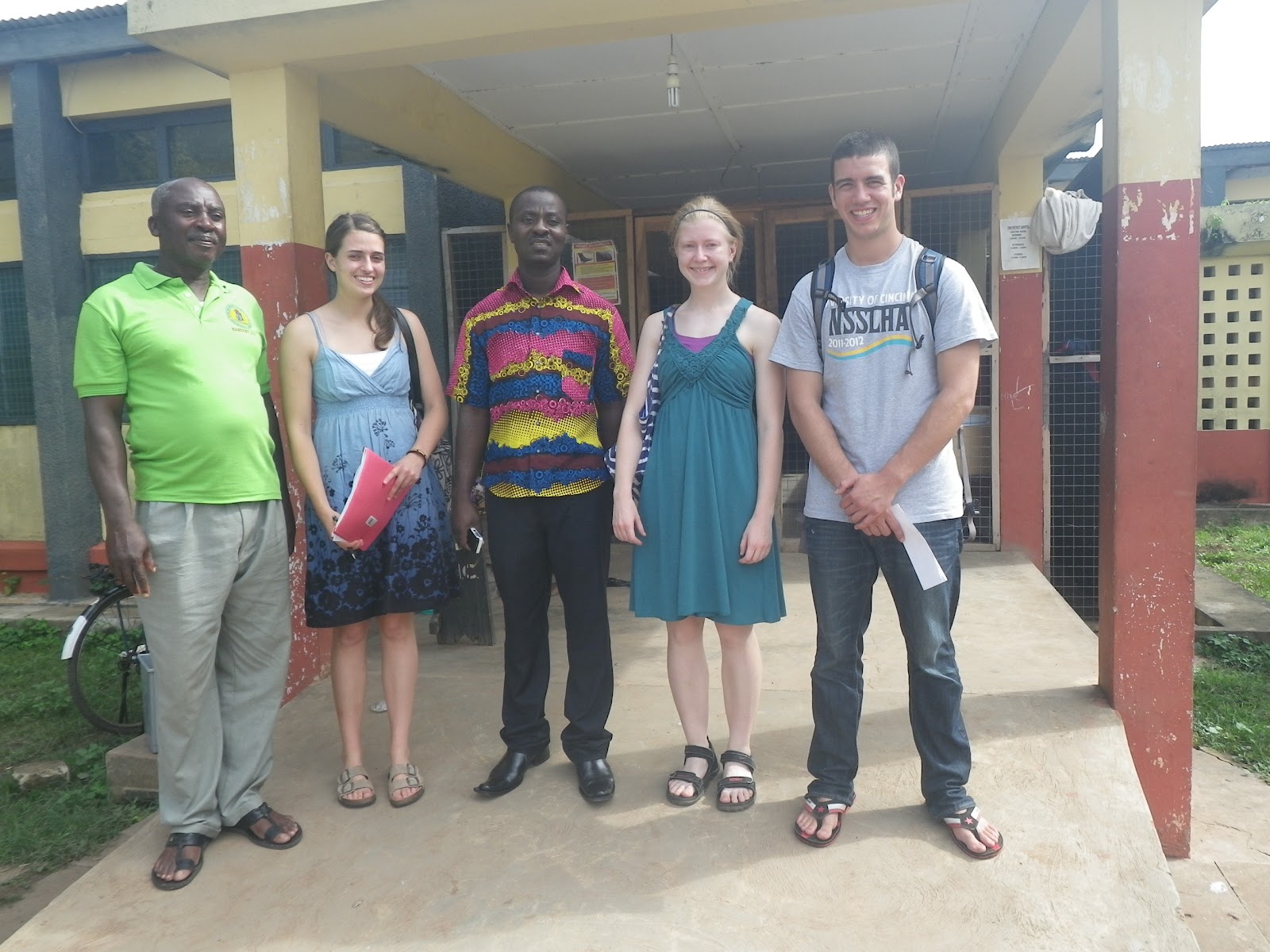
Emmanuel, Helena, the Regional Minister, Mollie, the MCE of Sunyani, and Chelsea
During that time Mike, Clayton, Peter and Govina were nursing the truck back to Kumasi with the generator. We switched trucks in Kumasi, so that Govina could get his truck properly fixed and we took off into the magazine. After fighting the usual stop and go traffic, we were directed to another electrician within the magazine who could check the health of our generator. After a few test the electrician told us that our problem was actually much simpler than we thought. The generator salesman told us the wrong neutral wire, and we had been using two live wires to check the voltage with light bulb, giving twice the required voltage. After seeing the generator light up a bulb using the correct wires, we knew everything was okay, and we set off to buy Peter a voltmeter so that he can check the generator at the site with more than a light bulb.

That night we were all in Kumasi again and as it was our last night there, Emmanuel and his family put on a party at their house with the whole family as well as some of Emmanuel’s students.  There was a delicious array of Ghanaian dishes including jolof rice, fufuo, goat soup, chicken soup and plain rice with a red sauce.  For dessert, Mollie baked an apple crisp because we found out that Adjoa’s (Emmanuel’s wife’s) favorite American food is apple pie.  It went very well with the vanilla ice cream and fresh mango slices that were also being served!

After dinner, dancing was the theme of the night, and with our friend Govina as DJ, it was hard to keep from tapping your toe to the music.  Luckily we had some help form the Ghanaian youngsters in learning the newest dance style in Ghana, Azonto.  The stars of the night were Emmanuel’s four kids though, because they were all getting in on the fun of dancing, even Kwaku at only 13 months of age!


Kwaku
Mike, Clayton, and Yaw eating ice cream
Mike and Clayton, with their electrician friend, Peter
Written by Mollie and Mike

Waste in Sunyani and Donations – July 30


Mollie called the Minister of Environmental Health this morning to set up a tour of the final disposal site for solid and liquid waste for Sunyani.  The goal of the tour was to assess whether the site could be the topic of a senior design project.  Mollie and Helena met with Daniel, the second in command for Environmental Health in Sunyani.  He talked to us at the district assembly first and then arranged for a truck to take us to the site. 

The solid waste is currently dumped on site by a contracting company paid for by the central government in Accra, providing a free garbage pickup service for individuals and businesses.  The liquid waste is currently being discharged into a lagoon system for free by private companies that are paid by individuals and businesses.  Daniel indicated that they are very interested in obtaining a truck scale so they can start charging the private companies for use of their lagoon.  He also mentioned the need for increased use of land cover over garbage dumped on the site daily.  Right now the garbage is only covered once a month. 
Mollie and Daniel discussing liquid waste disposal
Despite these challenges, Daniel was justifiably proud of Sunyani for having such an advanced waste processing system for the area.  He was especially proud of Sunyani being named the Cleanest City in Ghana 4 years in a row!  He was very excited about the idea of having Michigan Tech students design an improved system for the city and we plan to be in contact about the details of the project. 

That evening we had a lot of things to sort out in our rooms, including preparing gifts to give to all the people that have helped us out so far here in Ghana.  We also decided where to give our remaining educational supplies that we had in our luggage, and our biggest task was allocating the supplies in the shipment that we sent in May.  The update on the shipment is that it has arrived in Tema, the biggest port of Ghana, but it is still going through a clearing process, so we will not be able to distribute it’s contents ourselves.  Fortunately, we had already marked many of the books and supplies with which location they were intended for, but some items were still unmarked, so we worked on writing up clear instructions for the MCE of Sunyani as well as Emmanuel so they can distribute the supplies in the next few weeks when they are available. 


The Whole Group in Kumasi – July 27-28


 On Friday the 27th, the group was all in Kumasi.  Clayton and Mike picked up a few extra parts for the lister engine while Helena and Chelsea took a tour of the biochar reactors in Kumasi at SRI and then visited with Mollie at the Opuni house.  That evening we all got to talk to the India group by phone, which was really fun!  The Opunis served us a delicious meal of ampesi (a spicy cabbage and carrot dish, similar to coleslaw) and boiled yams and we got to play with the four kids!  The electricity went out for part of the evening, but it came on in time for some of us to watch the second half of the Olympic opening ceremony.  

Chelsea with Yaw and David, two of Emmanuel's sons
The next morning we had a leisurely start to the morning and then Mike, Clayton, Helena, and Chelsea decided to give Kumasi’s Central Market another go.  After a bit of a wait, we were able to catch a tro-tro to the middle of the city, where overwhelming traffic convinced us to hop out a bit before our destination and walk the remainder of the way (aided by Clayton’s directional knowledge).  The sun was hot and the market was busy, but that didn’t stop us from jumping right into the chaos with bargaining and buying.  

After a couple of hours and several successful finds, we headed out to the transit station.  There we were joined by Mollie and, finally fully reunited, we loaded onto a bus and headed back to Sunyani.  Once in Sunyani, Emmanuel (who had travelled near Sunyani for a funeral earlier in the day) drove us back to the dorms and accompanied us to a pizza dinner.  Following our meal, Helena, Mike, and Emmanuel partook in the live music and dancing just outside the restaurant.

Written by Mollie and Chelsea

Nsawkaw - July 22


Chelsea, Helena, and Mike were met in the morning by Godwin, one of the drivers from FORIG, who would accompany us on our trip to Nsawkaw. In Nsawkaw, we needed to visit the Tain District Hospital to discuss the needs of the hospital with Dr. Rockson, and if still applicable, to get the necessary information to arrange a shipment of repurposed medical equipment in the coming year. We also planned to visit the senior high school where last year’s group donated several netbook computers and other supplies.

Chelsea, Godwin, and Mike at the back of the tro-tro to Wenchi

Helena in the tro-tro to Wenchi

We had to take a few taxis to get to the right transit station in Sunyani from which we could take a tro-tro to the town of Wenchi, followed by another tro-tro to Nsawkaw. Tro-tro rides are always interesting- at one point, our tro-tro had overheated, so the driver just flipped up the front seats (where the engine was apparently just underneath) and poured water on the engine- filling the tro-tro with steam- until it was cooled enough. All the Ghanaians in the tro-tro turned to grin at us at that point, and said “Welcome to Africa!” At the transit stations, we were also on the lookout for Ghanaian donuts, which are a really common food sold on the streets here, and they normally consist of just a ball of deep-fried dough. At one of the stations though, Mike and Chelsea spied what looked like sugar-covered donuts, and we searched for them throughout the day after that, without success.

In Nsawkaw we were greeted by Mr. Brobi, a man who has worked with Pavlis in the past.  Mr. Brobi facilitated our day’s meetings at both the hospital and the school. First we went to his house, a nice place where future Pavlis students would be welcome to stay if they needed to be in the area multiple days. Then we visited the Tain District Hospital- a very nice place with a TV in the waiting area (a Chelsea soccer game was on while we were there) and several green courtyards. Most of the hallways were open-air. We were led to Dr. Rockson’s office, where we discussed the state of the hospital’s needs, previous obstacles to effective communication, and his (and the hospital’s) interest in working with MedWish, an organization that repurposes medical equipment for the hospital’s in need.

With Mr. Brobi (left) and Dr. Rockson (middle)

In order to better familiarize us with the needs of his workplace, Dr. Rockson then took us on a general tour of the hospital. We took several pictures and listened to Dr. Rockson’s explanation of the different areas of the hospital. Finally, we shook hands (as always) and left the hospital to walk to the senior high school to meet with the headmaster (we couldn’t see any students since it was a Sunday). We walked about fifteen minutes outside of town to a school surrounded by a huge open field. The classrooms were open-air, but the current, as well as the former, headmasters who greeted us ushered us into an enclosed room, where we discussed how the supplies they received last year are working for them, and what their other needs are.

They really appreciate the ten or so computers which Pavlis gave them last year, because they can use them to teach the students basic computer skills, which many students in Ghana can only learn theoretically because they don’t have the computers to try it out themselves. The books and other supplies were given to the students, and were also appreciated. The headmasters explained that the senior high has not only switched from being a private to a state-run school this year, but they will also soon be moving to a new building on the other side of town. What they would really like to have near the high school is a community center filled with more computers and books, and they would need whatever assistance they could get, not only with the supplies for filling the center, but with the building materials as well. We emphasized that although we will pass on this information to next year’s group, whether or not they can help will depend on their resources. We wrapped up the meeting by signing the school’s guestbook, and had the excitement of seeing the signatures from last year’s Pavlis students who visited.

The guestbook at the Nsawkaw High School

Finally, we walked back into town to make our way back to Sunyani, taxi and tro-tro style. The only hiccup was that our tro-tro in Wenchi had a broken headlight, so we had to wait a couple hours until it was ready to go. The driver was pretty fast though, so that made up for some time! ;)

Written by Helena and Chelsea

Mollie Goes from Sunyani to Kumasi - July 20-21


On the 20th, Mollie, who was feeling much better, was released from the hospital.  She waited with Helena and Chelsea keeping company until the evening when Emmanuel, Mike and Clayton arrived from Kumasi.  That afternoon they received a visit from Lawrence from Babianeha along with his brother Williams.  It was great to see Lawrence, who helped us out a lot in Babianeha when Mollie first got sick.  Later that evening, we got a visit from Tony and Ben, both friends from the dorms, which was also very nice. 

Lawrence visiting Mollie


When Emmanuel arrived, Mollie went with him and spent the night at Emmanuel’s mother in law’s house in Sunyani, along with Chelsea.  The next day, Mollie drove to Kumasi with Emmanuel to have some time to rest at his house, with his family.  The whole family was very welcoming and accommodating!

Thursday, August 2, 2012

Biochar at Babianeha and Meeting Dr. Jacob -July 16


Today, Helena, Mike, and Clayton went to teach some science lessons at the school in Babianeha near Emmanuel’s family’s house.  The students we were teaching were junior high-aged kids, and we had a class of about 40-50 Form 3 students (similar to 8th grade). First, we met with the headmaster, Watuza, to explain what we were interested in doing with the students. Since both we and the headmaster want to have the students carry out a biochar garden experiment (where they will measure the growth of plants with and without biochar in the soil in order to see the effects biochar should have on increasing crop yield), our plan was to start them with a lesson on the scientific method, and then we would have them discuss the different aspects of the experiment in groups in order to develop their experimental plan.  After Helena gave a brief explanation on how to form a hypothesis, how to determine variables, and how to measure and observe data, Watuza divided the class into three groups (with Mike, Clayton, and Helena each leading one group) and we headed out to the garden plot that the school had fenced in for the students’ use.

Explaining how to set up an experiment

The teaching method in Ghana is mostly a lecture and memorization style where the answer to a question is just regurgitated, so during the classroom lesson, the students seemed to have difficulty understanding what were trying to tell them; much of the time they couldn’t answer quiz questions without looking at their notes, and our American accents didn’t do anything to help them understand either.  However once we got out to the garden and began asking them how they would plan their experimental garden, they were bursting with ideas about weeding, crop variety, planting etc.  They clearly knew a lot about growing and farming, a lot more than any of us did. 

We all had a lot of fun interacting with the students in our respective groups. Clayton had a little bit of a smaller group and tried to make a game out remembering all of their names, some of which were easy (one kid went by the memorable nickname “Noble Rasta”) and some of which were a little harder to say right (Adymaya). In Mike’s group, his students offered him a red pepper to eat. It was lucky that Mike declined the offer, though, because the students then told him that this pepper was so strong, that if he ate it, it would make his throat swell up. Helena was amused by her group when they got into a heated five-minute argument about whether or not it was possible to count all the okras on an okra plant, and how some students would help her out by keeping the rowdier ones in line.


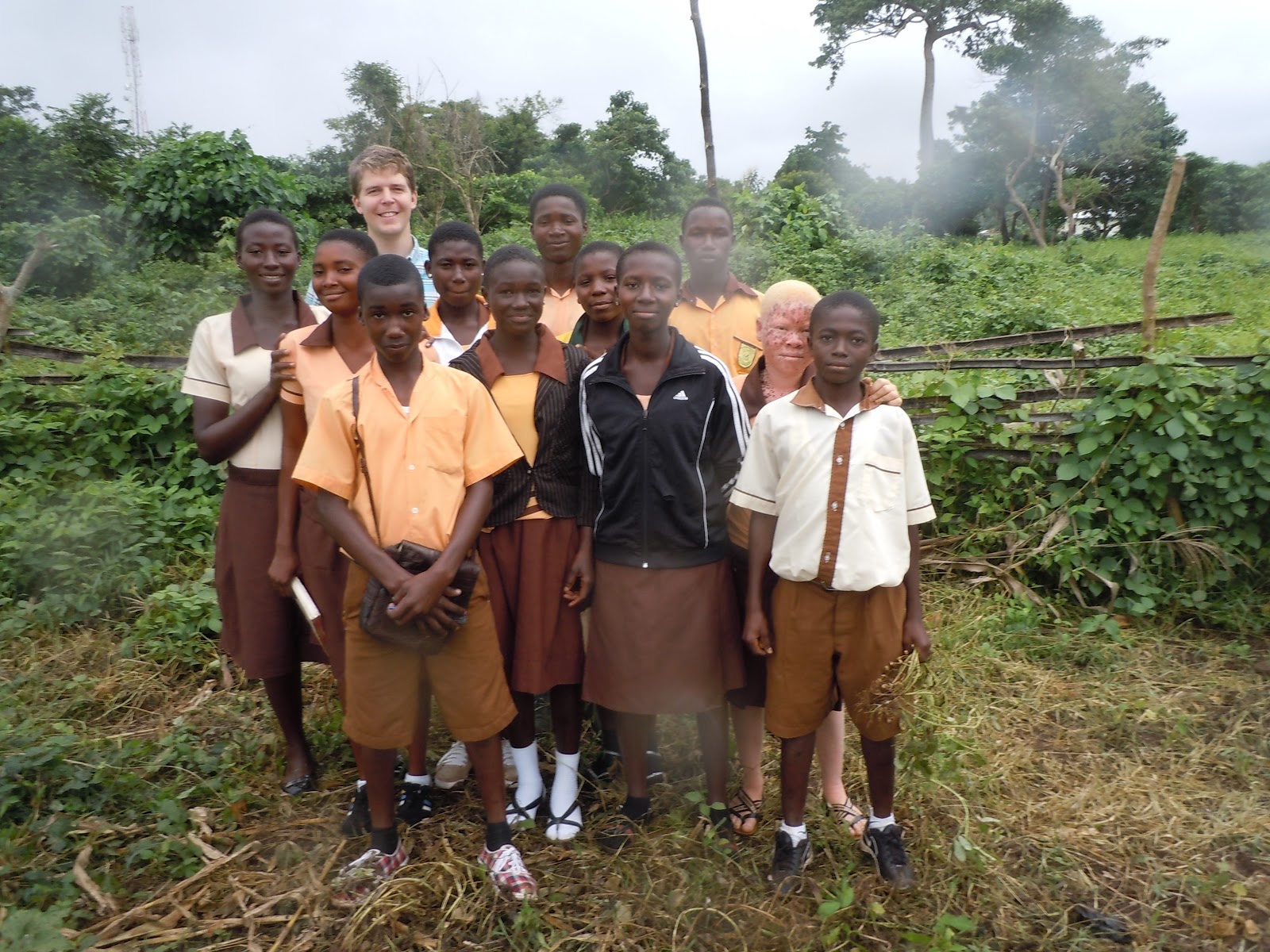
Clayton's group

Helena's group

Mike's group

At the end of the discussion session, all the students wanted pictures with us, so we obliged. Watuza wrapped up by letting us know that the garden would be cleared and prepared in a few weeks’ time in order to start the garden, and that they would also like us to come back sometime so we could be there when they make biochar in the community. We said we would do our best, and then as a parting gift, we gave the junior high a digital camera with which they could take pictures to further document their garden.

We then stuck around the school another hour or so to do science demonstrations with the other classes at the junior high, and Clayton and Mike did a great job explaining and demonstrating how molecular interactions allow a skewer to be poked through a balloon without popping it. This demonstration was made difficult though, by the fact that Ghanaian balloons appear to be a bit different in material from American ones, but we were still able to get the demonstration to work, and the students enjoyed it. Lastly, we were led into some other classrooms just to say hi to a few groups of students who had been displaced from their regular school building due to damage from a storm.

Clayton and Mike demonstrating some polymer science

It was then time for us to travel back to Sunyani to meet up with Chelsea and Mollie. We waited at the taxi station in Babianeha for a while (the taxis don’t leave until there are enough people to fill them) before riding to Dormaa, where we had a pleasant journey on the bus ride to Sunyani. A group of school kids snuck up and sat by us on the bus, giggling about having had the nerve to come sit next to the obronis (white people/foreigners). We had some fun conversation with them about snow, each others’ names, and whether the trees in Michigan have leaves like they do here in Ghana.

When we arrived in Sunyani, Clayton, Helena, and Mike joined Chelsea to meet with Dr. Jacob Abrebese, the Medical Director of Sunyani Regional Hospital as well as an assemblyman for the village of Nsawkaw.  Dr. Jacob, or Jacob, as he insists on being called, has been extremely instrumental to groups in the past and his ideas and interest in the Pavlis program are as strong as ever.  Some of the first words out of his mouth upon introduction to our group were an emphatic, “When will you come to our village?” Chelsea explained to him the efforts we made to collect information in order to ship re-purposed medical equipment to the Tain (pronounced Tine) District Hospital throughout the past fall and spring semesters.  However, due to an inability to sustain adequate communication with our medical contact there, efforts were put on hold until further communication could be achieved. 

In discussing the proposed project with Jacob, however, it became very clear that the Nsawkaw community would be perhaps more interested in a joint shipment of supplies involving collaboration between their education and health boards.  That is, while they think medical equipment may serve good purpose, books and educational (especially related to Information, Communication, and Technology—or ICT, as they commonly refer to it) support are of equal or greater need.  Jacob insisted that the time to act should be soon, as upcoming political elections may drive politician financial support in shipping items.  Further, he was especially intent on Pavlis having more direct interaction (i.e. doing lessons in schools, etc) with the community.  While we were unsure to what end we would be able to facilitate Jacob’s high hopes (as from here on out, our schedule was filling up pretty quickly), we did already have plans to visit Nsawkaw on the upcoming weekend to get a better idea of how future Pavlis cohorts can have a positive impact there. 


*Note: This post was written by Clayton, Helena, and Chelsea

Monday, July 30, 2012

Duasidan with a bit of Babianeha - July 14 and 15

When the girls’ second morning in Babianeha dawned, the Opuni household had once again prepared us a generous breakfast. Mollie wasn’t feeling too well that morning though, so to be safe, Chelsea and Helena (as well as our friend Lawrence from the Opuni house) accompanied her to the hospital in Dormaa in the afternoon. They just missed Clayton and Mike, who arrived in Babianeha shortly after the girls left, so unfortunately we weren’t able to be reunited that day.

On Sunday the 15th, Mollie was doing fine, but Chelsea and Emmanuel went with her to the hospital in Sunyani where she could be more comfortable. Meanwhile, Helena, Mike, and Clayton went to the village of Duasidan to talk to the community about the monkey sanctuary. Kwadwo, one of Emmanuel’s brothers and the assembly man for Babianeha, had contacted Jacob Obiri, the assembly man at Duasidan, to set up this meeting for us. We had actually been expecting to just meet with a handful of people, but when we arrived, we were ushered into a courtyard where about thirty community members sat all the way around the square. Formalities in Ghana are all about hand-shaking, so we shook all their hands, and vice versa. Then we (along with Kwadwo, who translated for us) sat on the elevated side of the courtyard, and our discussion with the community could begin.

First, we explained our purpose for being in Duasidan: to help further the mission of the monkey sanctuary, that is, to promote the protection of this habitat for the monkeys and the biodiversity of both the plants and animals in the area. We would like to help by providing the community with resources for advertisement, but we need the community’s opinions and input. We showed the community members the draft of the brochure for the sanctuary, which had been designed by the marketing department at FORIG. Everyone around the room was nodding in satisfaction as they saw the design, and seemed to agree with our idea of distributing the brochures to hotels and other locations in Sunyani, as well as keeping copies at the visitor’s office. We also explained that we planned to design a poster for the visitor’s office, as well as a few road signs to be posted at convenient intersections near Duasidan. The community gave us a few suggestions for places where the signs should be located.

We then established that Jacob, the Duasidan assembly man, would be the English-speaking phone contact for the sanctuary, and the community also decided on which days of the week and during what hours the sanctuary would be open for tours. Our entire interaction with the community was very interesting for us, because we would start by telling Kwadwo what we wanted to ask, then Kwadwo would approximately translate our question for the community, and then the community members would debate heatedly, back and forth, for up to ten minutes, and then Kwadwo would again translate the verdict for us. People were especially passionate about the question of what the open hours for the sanctuary would be, since they are a farming community, so it is important to work around the schedule of the sanctuary guides who farm to earn a living. The discussions were interesting in that people would always say times and numbers in English, but the rest would be in Twi. So we would hear “somethingsomething 10am somethingsomething” and so on. Needless to say, it was a great experience to be able to sit in on this community meeting which was so different from how these things work in our hometowns.

Eventually, the community was hesitant to discuss more, due to the fact that the Duasidan chief (who actually resides in Dormaa) was not yet aware of our presence, so we said we would make plans to contact the chief and come back another day in the coming weeks to wrap up our questions for the community. We also needed to get information from the chief about the history of the monkeys in Duasidan, because the chief has a document, which details a study done by the Ghana Forestry Commission about ten years ago, which has the monkeys’ history in written form (so far we have only heard it orally, so we want to make sure we have a consistent story before it is printed in the brochures).

As the meeting wrapped up, we asked the community if they had any other needs they wanted to address. The main issue which came up centered around education. Like many rural communities, Duasidan schools lack books, computers, and other resources for students as well as the greater community. The community members expressed interest in next year’s Pavlis students working with Duasidan to bring in supplies for a community center, similar to how Pavlis worked with the community in Babianeha two years ago. At the very end of the discussion, the lone woman in the room stood up to say that if possible, we should return to Duasidan before school lets out on July 26, so that we can visit the school and meet the students. We said we would certainly try, and with that, the meeting ended with us going around and shaking hands with everyone twice (again), and then we rode back to Babianeha. The driver who drove us and Kwadwo was a very assertive driver who sure got going pretty fast down those dirt roads!

When Helena, Mike, and Clayton got back to the Opuni house, dinner was waiting for us, and we happily dug in. We were also able to check in (over the phone) with Mollie and Chelsea (who were in Sunyani by evening) before turning in for the night.

(Written by Helena)

Friday, July 27, 2012

Generators and Funerals (Not Ours!) – July 13


 This morning Chelsea, Helena and Mollie woke up early and enjoyed a wonderful breakfast of scrambled eggs and veggies with toast prepared for us by Emmanuel’s family, specifically Lawrence, a very nice and helpful guy around our age.  After breakfast we went to visit the junior high school, where they were in the middle of their normal Friday worship. 

The students were joyfully singing and dancing in the classroom when we went to greet them.  The teacher asked us to say a few words to the class, so Helena told the students how happy we were to hear their beautiful singing this morning, and how we are looking forward to starting the biochar garden with them. The students, however, just looked blankly at us, so the teacher repeated everything that Helena had just said, because he realized that the students simply hadn’t understood the American accent. We found out that we wouldn’t be able to teach at the school that day, so we would have to come back on Monday to do our biochar garden lesson.

The headmaster took us to see the bounteous garden that the school maintains, full of onions, maize (corn), cabbage, okra, ripe hot peppers, cowpeas, cocoyams, and more!  He plans to use the garden next year to teach about crop rotation and we hope to also incorporate a section of the garden using biochar, to increase yield.  There is a sawmill next door to the school where they can source sawdust to make into biochar. 

Next, we visited the community center established by past cohorts and assessed the state of the computers in use there.  From there, we were accompanied by Lawrence, Reagan, and Adinkra (all guys around our age) to the Cote d’Ivoire border, where we walked along it for a ways, comparing the differences between each country.  Badukrum is the village that is between the Ghana customs border and the Cote d’Ivoire customs border, where the citizens have dual citizenship, share languages and currencies.  We changed about 50 cents into sefa coins, used in Cote d’Ivoire, as souvenirs.  The Ghanaian street lights are poles with four cables strung from each while the Ivorian lights are on cement posts with one cable on each.  There is a path past the village that follows the border all the way north and south.  We walked along it a ways and came across some grave sites, sorted by religion. 

After a mid-day nap we returned to the community center where we met some kids and played a couple jumping games, including jump rope with ropes donated by a previous Pavlis group, as well as a local jumping and clapping game called ampe (pronounced ahm-pee).  There we met Adinkra again and he led us to the one week celebration of a man who had passed away in the village.  In Ghana, funerals are quite celebratory, but this was not the same as a proper funeral, for which they set the date today for August 2. 

At this ceremony, there was traditional drumming and singing, accompanied by a couple traditional dancers at a time.  When we arrived, we greeted everyone (including all the chiefs and elders) in the first row of chairs then sat down to observe the proceedings.  After a short time we were asked to dance, and with varying degrees of apprehension, we did do our best imitation of the crouched, small steps of the other women we had seen dancing.  We were comforted by the fact that we seemed to be well received and the gesture was appreciated.  As we danced, three women gave us their red and black shawls to wear, as these are the traditional colors of death in Ghana and we were not dressed accordingly (as we had not known we would be going to a funeral). 

Traditional musicians and dancing
When we finished dancing, we returned the shawls and sat down again to soak in the call and response singing, the different percussion instruments and the more expert dancing of the local women.  After a time we were invited into the neighboring house for a drink and were offered some pop, which we accepted, as well as traditional palm wine, which we all tasted.  The palm wine was sweet and served traditionally in dried gourds.  The men that drank the wine poured the top off of the very top of the wine onto the ground to share with the ancestors.  Adinkra told us that a practical reason for this is to avoid the impurities that float to the top.  After finishing our drinks we returned and continued watching the celebrations until the ceremony ended. 

Upon returning to our hosts’ (the Opunis) house, we were greeted with a dinner of rice, cocoyam leaves, chicken and spicy fish sauce.  After dinner, we rested and watched some kids playing football (soccer). 

---

Meanwhile, Mike and Clayton started the day early and met Peter at 8am to grab a tro-tro into town (Kumasi) where he knew some places that had generators.  We went from place to place, covering a good portion of the city and a greater portion of the day without having any luck finding what we needed.  It turned out that while “all-in-one unit” gas generators are extremely common in Ghana, many people were often at a loss when we explained we were looking for only the generator/alternator part.  We kept traveling and finally found (kind of) what we were looking for at a smaller engineering bay on a street corner.  They had a generator there that would make a decent match for our engine, though it was bolted into a frame with an engine already.  The man said that he would remove the engine for us if we didn’t want it. 

After a long day of marching here and there we finally came back to FORIG to say goodbye, and Govina took us across the city once again to catch his own bus and help us catch one back to Sunyani.  It was dark by the time we got there (although, it’s only around 6:00 pm when it gets dark here) and finished the night with spaghetti and a rousing two hours of laundry.  The next morning we planned to head off to Babianeha ourselves.  We also called the girls to see how they were doing and how their trip had been.

Friday, July 20, 2012

Meeting the MCE, and Travel- July 12


This week’s tasks required us to split apart once again, but not before we had a meeting with the MCE of Sunyani, more or less the equivalent of a mayor.  We were greeted outside his office at the Municipal Assembly building at 10am by the Director, who we had met the previous day.  He led us inside the office and into the sudden sight of about seventeen of the important ministers and managers of the city.  We were invited to sit for the meeting and did so, a little nervously. First, we went around and shook hands with everyone. Then we sat down, and it was everyone else’s turn to come and shake hands with us. Everyone in the room introduced themselves, and the Director gave an introductory speech about our presence there.  

For the most part, the Director and the MCE did the majority of the talking, explaining their main concerns for their district and how we might be able to help. One of their concerns- which we are already assisting with through our book shipment- is the lack of supplies, especially books and computers, in their schools and communities. The minister of education also spoke up regarding education methods, and proposed that when we visit the local schools, we can observe and learn about their teaching methods, while we teach them about ours. Lastly, the MCE discussed the details of our book shipment, which will be picked up and paid for by his office once it arrives at the port in Tema within the next couple of weeks.

At the end of the meeting, we all shook hands again and exchanged contact information with the MCE as well as the minister of education, who had offered to show us around the local communities next week. After we left the Municipal Assembly, it was time for our group to split up for a while- Mike and Clayton took a taxi to the Sunyani bus station and nabbed the last seat on a bus to Kumasi while the girls expected to stick around Sunyani for a bit and take care of some work before traveling to the Babianeha for the weekend to get the middle school’s biochar experiment started and re-visit the Duasidan Monkey Sanctuary to discuss some advertising ideas with the community. 

The plan for the Mike and Clayton in Kumasi was to meet our electrician friend Peter and spend the day searching for an electric generator/alternator component for the Kwame Yeboahkrom Lister engine. By the time they navigated their way across Kumasi and met up with Peter however, it was too late to go looking that day.  Mike and Clayton spent the night in the FORIG guesthouse on campus, while Emmanuel’s wife was very kind and made them each a mountain of rice and mutton for dinner.

In the meantime, Chelsea, Helena, and Mollie spent much of Thursday afternoon following up on project work. They went to the Ridge Experimental School again to check in on the school’s supplies and computers, and to find a time when our group could come and do some science demonstrations similar to what we did at the CSIR Basic School in Kumasi. They met Jackson, the former headmaster at Ridge, who showed them around and explained that the students have exams next week, so we will not be able to visit until the week after.

Next, a trip to an internet café in Sunyani (a small room with ten or so computers, in which we paid the U.S. equivalent of about 25 cents for a half-hour of internet access), allowed Helena, Mollie, and Chelsea to check on the progress of the Duasidan Monkey Sanctuary marketing documents. They arranged for Mike and Clayton to pick up the documents at the FORIG campus, so that they could bring them to Babianeha on Saturday.

The Ghanaian version of Target.
After a late lunch and some fast packing, the girls took a taxi to the transit station, hopped on a nearly full bus to Dormaa (Note:  In Ghana, busses are less likely to depart at regular times since they usually don’t leave until they are full, so getting on to a crowded bus meant a sooner departure!), and began their journey to Babianeha.  After a comfortable (if bumpy every once in a while) one-and-a-half-hour ride, Mollie, Chelsea, and Helena arrived in the town of Dormaa, where they convinced a taxi driver to take them on the twenty minute drive to the Opuni house in Babianeha (the Opuni house being the home of Emmanuel’s mother and excellent host, Dora Opuni, as well as an assortment of his relatives).  

Chelsea, Mollie, and Helena's bus ride to Dormaa.
 Upon the girls’ arrival, helpful residents carried their bags and ushered them into their compound, where Emmanuel’s brother, Kwadwo, spent about ten minutes haggling (in Twi) with the taxi driver for us over the price of the ride. The discussion was very interesting to us, because Kwadwo and the taxi driver alternated between raised angry voices and laughing. After the taxi driver was talked down from twelve to seven cedis (7 cedis ~ 3.5 USD). The girls sat down to a meal of cooked yams (plain, so as to please Chelsea) and a vegetarian dish of cocoyam leaves (so as to please Mollie) which had already been prepared by the Opuni household.  The girls then retired for the night in the Opunis’ guesthouse, a beautiful newly constructed home that had not yet been used by the family themselves.

*Note: This post was written by Clayton, Helena, and Chelsea.

Tuesday, July 17, 2012

Greeting the Town- July 10 & 11

Tuesday the 10th was a day filled with going to the Sunyani open market for ingredients for dinner (we always have particular fun at the stand where we buy eggs, because the friendly women there, Nana Afia and Nana Yaa, always try to teach us a few new phrases of Twi when we visit), compiling our video footage, and doing a bit more writing for project documentation. At the end of the day, Mike, Chelsea, Mollie, and Helena went for a run along the street that goes by our dorms, during which most of the people who saw us go by either stared, laughed at us, or asked “Where are you going?”. As we realized later, people do jog around here, but the locals only go in the cool early morning hours.

One small section of the open market in Sunyani

Clayton holding one of the cocoyam leaves (similar in taste to spinach) we got at the market


On Wednesday, our morning was filled with errands and chores:  buying fresh food for the day, picking up a couple of science demonstration supplies, and filtering water.  Around noon, Emmanuel arrived (he had driven from Kumasi) to introduce us to a variety of individuals who will be instrumental throughout the remainder of our stay in Sunyani. 

We were introduced to Andy Ampong, the new headmaster at Ridge Experimental Junior High School, a site of donations and lessons from previous Pavlis cohorts.  Then, on our way to briefly visit another project location, the Abesim Community Center, we stopped in at the Sunyani Municipal Assembly, where we met the director and made future plans to meet with the Sunyani MCE (Municipal Chief Executive)- the official who has taken responsibility for the payment of our book shipment.

Emmanuel knows just about everyone in Sunyani, so our greetings did not stop there.  We stopped downtown and met Emmanuel’s mother-in-law, Comfort, at her local business, the Glory Pharmacy.  We drove to see the beautiful home of the Regional Minister and waited outside a meeting of all the area MCEs for the chance to be formally introduced to Kwasi Oppong Ababio, the Sunyani MCE, with whom we planned to meet the next day.

We met with the head chancellor of Sunyani’s new local environmental and natural sciences university (to be called ENAT) and became acquainted with Dr. Solomon Fofie, the head physician at Sunyani Polytechnic (another local university).  We also drove to see the Sunyani Regional Hospital, the workplace of Dr. Jacob, one of our main contacts for assessing medical needs in the area.

After this full day of greetings and introductions, Emmanuel delivered us back to our dormitory room and then headed back to Kumasi.  As for us, thoroughly worn out from meeting so many new faces, we made dinner (a spicy ginger/lime stir-fry), had our group meeting, and called it a night.   


*Note: This post was written by Chelsea.

Tro-Tros and Kwame Yeboahkrom – July 9


We're sorry for the delay again, everyone! We bought an internet modem last week, but the provider has been down, so we have had very limited internet access. We should be able to put up several new posts by the end of today, though. Thank you all for your patience! :)


***

We all awoke Monday morning wondering if the recently returned power was really all that appreciated. The local student radio station adjacent to our room greeted us at 5am blaring their music from a small radio in their room, disrupting all of our sleep. But we were still able to get moving at 7am to enjoy a nice breakfast of eggs, toast and avocado prepared by Mollie, Chelsea, and Helena, while Clayton and Mike slugged their way through their morning.

This was our group’s first day apart from one another. Helena, Chelsea and Mollie stayed in Sunyani to sort out tasks around our dorm, while Clayton and Mike set out to Kwame Yeboahkrom to deliver the Lister engine housing plans and create a parts list, accompanied by our Kumasi electrician friend Peter (pronounced “Peetah”). This trip was also another first because instead of using Emmanuel’s forestry trucks to get to the village, we took the famous Ghanaian tro-tros the entire way, which created quite an adventure.

Starting in Sunyani, the first tro-tro trip was to Dormaa, with Mike and Clayton crammed in the first row and Peter behind. We entertained ourselves by pointing out the various oddball ads, business signs and taxi slogans along the way.  One sign appeared to be trying to tell us not to simultaneously lead small chickens while playing the trumpet.  From Dormaa everyone packed himself into the back row of another tro-tro, said goodbye to pavement, and bounced, rocked, creaked and banged all the way to the village of Ankrankwanta. From there, we took one last tro-tro to the clinic in Kwame Yeboahkrom, arriving there a bit after noon.

Working with the clinic’s doctor and our tro-tro driver- who, coincidently, also is helping with our project- we discussed the plans for the generator housing. We decided on a 10’ by 12’ room with one door and three basic windows for ventilation. The engine will be bolted to the floor with four studs imbedded in the cement that were delivered with the engine, while all other components such as the generator will be screwed in place after the building is done.

While we were in Kwame Yeboahkrom, our driver showed us another Lister engine being used in the village, which was previously unknown to us. This engine was powering a small grain mill, so although we still need to create our own system to connect a generator to ours, we at least have a working reference for what is needed to get our engine running.

After seeing the motor, we returned to the clinic and ironed out the rest of the details. We then shared a quick friendly chat with the clinic’s doctor and after Clayton attempted to speak Twi to a small crowd of laughing girls, we set off again in the same series of tro-tro’s back home. Leaving a little after 4:00 in the afternoon, and arriving home to the dorms around 8:00, Clayton and Mike joined the girls for a nice dinner of rice, fried cocoyam (a potato-like tuber), and breaded garden egg (like a mini eggplant) along with their best interpretation of no-bake cookies with locally available ingredients, ending another long successful day.  

The girls had a full day too, but with less travel: learning more of the ins and outs of the Sunyani market, organizing information from our projects so far for documentation, putting up blog posts, and cooking with ingredients from the market!


*Note: This post was written by Mike, though he wasn't here to post it himself.

Monday, July 9, 2012

Hello Sunyani! - July 8


When we woke up on Sunday morning, the power was out again.  The early Ghanaian sun, however, made the absence of electricity considerably more bearable!  We took advantage of the morning to become more familiar with our new home.  We gained access to a shared kitchen space (with counter space, several sinks, and even a gas stove!), met a Canadian summer resident of the dormitories, and got a head start on unpacking and tidying up our rooms. 

In the afternoon, the five of us caught a taxi to Sunyani’s market.  We satisfied hunger with a stop to eat the bread and pies to which we had previously been introduced.  Then, armed with a list, we explored downtown Sunyani.  We bought items ranging from onions and avacados, to butter and eggs, and even a couple of bandannas.  The Ghanaians we interacted with (most still dressed in their Sunday best) were very friendly.  Many were happy to have our business and even happier when we were able to slip in a word or two of Twi (i.e. basic greetings, introductions, and thank you’s). 

Four squished into the back of a taxi
Chelsea trying her pie
Though the Sunyani market was considerably less overwhelming than Kumasi’s central market, we were tired after a couple of successful hours and returned back to our dormitories.  Helena, Mike, and Clayton were able to wash some clothes (a far more time-consuming task when done by hand).  An attempt at a run was made, but prematurely concluded on account of pouring rain and approaching darkness. The entire group then enjoyed a headlamp-lit (as the power had yet to return) Minestrone soup dinner, as deliciously prepared by Mollie, Helena, and Clayton.  After 8 PM we again had electricity and Mike was able to tape-out dimensions and complete drawings for the lister engine’s housing structure.  We then discussed plans for the approaching day, and called it a night.

Big Trees and Kente Cloth - July 7


Our night at the Bobiri Butterfly Sanctuary was filled with sounds of the forest; we were lulled to sleep with noises of frogs, birds, and all kinds of insects.  We struggled out of our comfortable beds and into the kitchen around 7 AM.  Thrilled to have a large kitchen (and stove-top) at our disposal, we decided to make French toast.  Without milk or cinnamon or vanilla, and with honey as a substitute for syrup, we all enjoyed a warm and filling breakfast. 

Around 8:30 AM, one of the Bobiri guides arrived and ushered us through a couple of the forest’s trails.  We eagerly followed as our guide, another Emmanuel, cleared our path with a machete.  Emmanuel introduced us to many of the forests most notable trees, trees, mind you, that stretched high (higher than we could see) into the sky.  We climbed around wall-like buttresses of trees more than 300 years old, we played with rubber from a rubber tree, we (well, some of us) tasted the bitter bark of a Mahogany tree, and we dodged (some better than others) stream-like armies of biting ants.  After several hours out on the trails, we returned to our rooms and prepared to once again hit the road.

Huge buttresses on a huge tree!
Our guide demonstrating the use of a vine as a resting spot
After we piled into Govina’s truck, we were escorted to Bonwire, a town noted for producing a traditional Ghanaian fabric, kente cloth.  While there, we were able to watch craft-masters create marvelous designs with complex looms and diligent well-practiced fingers.  The craftsmen were eager to share their knowledge, they even allowed Mollie and Helena to sit down and try it for themselves!  Of course they sold their crafts there as well, so everyone got another chance to improve upon their bargaining skills.

Kente cloth community showroom with looms in use and fabric on display
Later in the day we gathered our line-dried laundry from Emmanuel’s home, grabbed two duffel bags full of useful items (left from previous cohorts), and bought some fresh bread and vegetables from a small market at KNUST.  We then drove (with Govina) back to our KNUST dormitory base in Sunyani.  When we arrived in Sunyani we were able to get good use out of our headlamps and flashlights—our entire dormitory was without power, and being 7 PM, Ghana was already very dark.  Unsure if the power would come back on at all, we delayed further unpacking, snacked on bread and peanut butter, and debated if we should go elsewhere for food and potentially electricity.  We were both surprised and excited when the power came back on around 8:30 PM.  Using hot plates, rice cookers, and cooking ware left from previous groups (thank you!) we prepared and enjoyed a makeshift stir-fry dinner.  We concluded the evening with a group meeting and discussion of plans for Sunday.

Saturday, July 7, 2012

Journey – Akwantuo: July 2,3


On our second day in Ghana we were introduced to Sunyani, a city approximately two to three driving hours west of Kumasi.  We settled into rooms at the city’s KNUST satellite dormitory; we will use these rooms as a housing base throughout the rest of our stay in Ghana.  We spent most of the day running errands (i.e. securing plane tickets for our advisor’s departure, exchanging our US dollars for Ghanaian currency, the cedi, and outfitting our new residence with common household items such as hand soap and dish detergent.  On our trip to the Sunyani market, we stocked some of our in-country phones with minutes and we were even able to try a popular local snack, pies (meat and onion filled bread, a seemingly distant relative of the pasty!).  We ended the evening with an even more familiar dinner (pizza!) with our advisors at their local lodging, the Eusbett Hotel.

Beginning the next morning, we had a very full day of traveling around with our advisors.  We were off just after 7 am and on the road to Dormaa, just outside of Sunyani.  The road has many speed bumps/rumble strips with two or three small strips in the road in a row.  After meeting briefly with a representative for the regional minister, we continued on to Kwame Yeboah Krom (Kwame is a common first name, Yeboah is a common last name and Krom means village.) To put it mildly, the road was extremely rough on the way to the village. 

We met a local government representative near Kwame Yeboah Krom and he lead us into the village, where we were visiting the Lister engine, a simple engine that was ordered for the village two years ago and just arrived a few months ago.  Our goal for this trip is to facilitate the building of a housing structure for the engine, to buy a generator, and to try to get the engine up and running.  It was very exciting to practice our small Twi phrases, as most people in the village didn’t speak English.  The kids especially got excited! This was our first time visiting a more rural area, and we had an enjoyable, if short, time.
Mike and Clayton checking out the Lister engine           
After visiting the engine, we visited the local representative’s home in the neighboring village of Okirakrom.  When we visit again to work on the engine for a few days, we can stay at his house.  In the courtyard there were a bunch of orange trees that were heavy with fruit.  In Ghana, oranges are green on the outside, but orange and juicy on the inside.  What a treat!

From there, we continued on to the village of Duasidan to visit the Duasidan Monkey Sanctuary, a relatively unknown location that the locals would like to develop into an ecotourism site.  Here, a large group of kids flocked with us and our two guides a short way into the 40-acre plot of forest.  In a clearing of bamboo, one guide started tapping on the sticks and pretty soon, we were surrounded by monkeys!  We had brought peanuts and small bananas to feed to them and they snatched them right from our hands!  One of our projects is to help advertise the sanctuary to tourists, so we took a lot of photos and videos.  Emmanuel sat down with our two guides to help translate and we taped an interview with them. 
The group with two local guides (left and second from left) and one of our divers, Govina (third from left)

Monkeys!

Chelsea feeding a Monkey

Next, we traveled about 20 minutes to Babianeha, where Emmanuel’s family is from.  Emmanuel’s mother had prepared a huge and delicious lunch of chicken, a cocoyam leaf (like spinach) dish, and jollof rice for us! After a quick meal, we visited the community center that was founded by Pavlis students in the past, interacted with the children who were there reading books and using the laptop computers, and then took a short walk to the Ghana/Ivory Coast border.  We talked to the border officers and then crossed over briefly.  It was pretty much the same as being in Ghana except for a few French phrases.

After our short visit to the Ivory Coast, we headed back into the vehicles for the long drive back to Kumasi.  We finally got in around 8 pm, settled into a guesthouse for temporary lodging in the city, and then concluded the evening for dinner with our advisors at the Royal Basin Hotel.


Sunday, June 10, 2012

Places

While we are in Ghana, we will be traveling all around the western part of of the country.  For those of you interested in touching up on your Ghanaian geography, here's a Google Map to help you keep track of the places we'll be writing about!

Friday, June 1, 2012

Shipment has shipped!

Hello World, and welcome to the travel and projects blog of the Pavlis Ghana group, 2012! 

Our big achievement last week was to send all the supplies that we have gathered to Ghana!  The shipment is going by boat (ship?) to Tema, the port city of Ghana, near the capital Accra.  The shipment is being sponsored by the MCE (Metropolitan Chief Executive) of Sunyani.  It should arrive while we are in Ghana and we will be able to distribute the supplies to upwards of four different schools and community centers in rural areas.  All of the supplies were either donated or purchased with money from our fundraising efforts.  Thank you to all of our supporters out there, including the Shipping Shop of Houghton for all of their help!!!

Chelsea, Mollie and Helena with the shipment
The shipment came out to a whopping 2.6 cubic meters, 1425 pounds filled with books, computers, and other school supplies!  Keep coming back for more project updates, there's plenty yet to do in preparation!