Showing posts with label Azonto. Show all posts

Sunday, August 5, 2012

Goodbye Sunyani, Goodbye Friends – August 1


Packing this morning was pretty hectic!  We had to get every last item out of our dorm rooms in Sunyani so we could check out and head to Kumasi for the night.  Once we had everything packed into the cars, Mike and Clayton headed to Kumasi immediately to work on troubleshooting the generator for the Kwame Yeboah Krom.  Mollie, Chelsea, and Helena stayed with Emmanuel in Sunyani for much of the day completing last minute errands. 

First we dropped Chelsea off at the hospital so she could get information from him about the medical needs of the region, as well as to collect Mollie’s medical report from her stay at the Sunyani hospital.  Then we dropped Helena off in the main market for her to pick up a few items.  Finally, Emmanuel and Mollie visited the District Assembly to deliver the shipment allocation to the director and to receive reimbursement for the shipment costs. When we were all done with our errands we all went to meet the Regional Minister (similar to Governor of a state). 

We had been trying to fit our schedules to a time he could meet with us since our arrival, and we finally got it right.  After waiting about half of an hour for his meeting to finish up, we got to finally greet the Regional Minister on behalf of the team, and all of Pavlis.  We took a picture with him and the Sunyani MCE and then went across the street to have lunch with them. 

Emmanuel, Helena, the Regional Minister, Mollie, the MCE of Sunyani, and Chelsea
During that time Mike, Clayton, Peter and Govina were nursing the truck back to Kumasi with the generator. We switched trucks in Kumasi, so that Govina could get his truck properly fixed and we took off into the magazine. After fighting the usual stop and go traffic, we were directed to another electrician within the magazine who could check the health of our generator. After a few test the electrician told us that our problem was actually much simpler than we thought. The generator salesman told us the wrong neutral wire, and we had been using two live wires to check the voltage with light bulb, giving twice the required voltage. After seeing the generator light up a bulb using the correct wires, we knew everything was okay, and we set off to buy Peter a voltmeter so that he can check the generator at the site with more than a light bulb.

That night we were all in Kumasi again and as it was our last night there, Emmanuel and his family put on a party at their house with the whole family as well as some of Emmanuel’s students.  There was a delicious array of Ghanaian dishes including jolof rice, fufuo, goat soup, chicken soup and plain rice with a red sauce.  For dessert, Mollie baked an apple crisp because we found out that Adjoa’s (Emmanuel’s wife’s) favorite American food is apple pie.  It went very well with the vanilla ice cream and fresh mango slices that were also being served!

After dinner, dancing was the theme of the night, and with our friend Govina as DJ, it was hard to keep from tapping your toe to the music.  Luckily we had some help form the Ghanaian youngsters in learning the newest dance style in Ghana, Azonto.  The stars of the night were Emmanuel’s four kids though, because they were all getting in on the fun of dancing, even Kwaku at only 13 months of age!


Kwaku
Mike, Clayton, and Yaw eating ice cream
Mike and Clayton, with their electrician friend, Peter
Written by Mollie and Mike

Kwame Yeboahkrom and the Death of a President– July 24th 2012

After another few trips into the magazines of Kumasi, the welding and parts for the generator set-up had all been completed and found for the lister engine project in Kwame Yeboahkrom.  Our caravan started with Mike and Chelsea returning from Kumasi along with Govina and Peter in a truck full of everything we were bringing.  Then at Sunyani Clayton switched in with Mike and headed out towards Dormaa and the village areas; Helena and Chelsea tro-troed their way there separately. 
            While we were riding in the truck, Govina began to hear rumors from his friends that something had happened to the President.  It turned out the President of Ghana, Atta Mills, had died in office.  We were told that rumors of his death were not uncommon since his health has been bad in recent years, but this time the rumor was true.  It’s a particularly strange time for such an unfortunate thing to happen because he was campaigning for reelection in the Ghanaian Presidential vote this December.  Now his VP, John Mahama, has been sworn in and will continue the elections.  Many people are wearing the red and black funeral cloth during the day, and the newspapers tell us there is a period of national mourning that will now extend until the late President’s funeral on August 10th. 
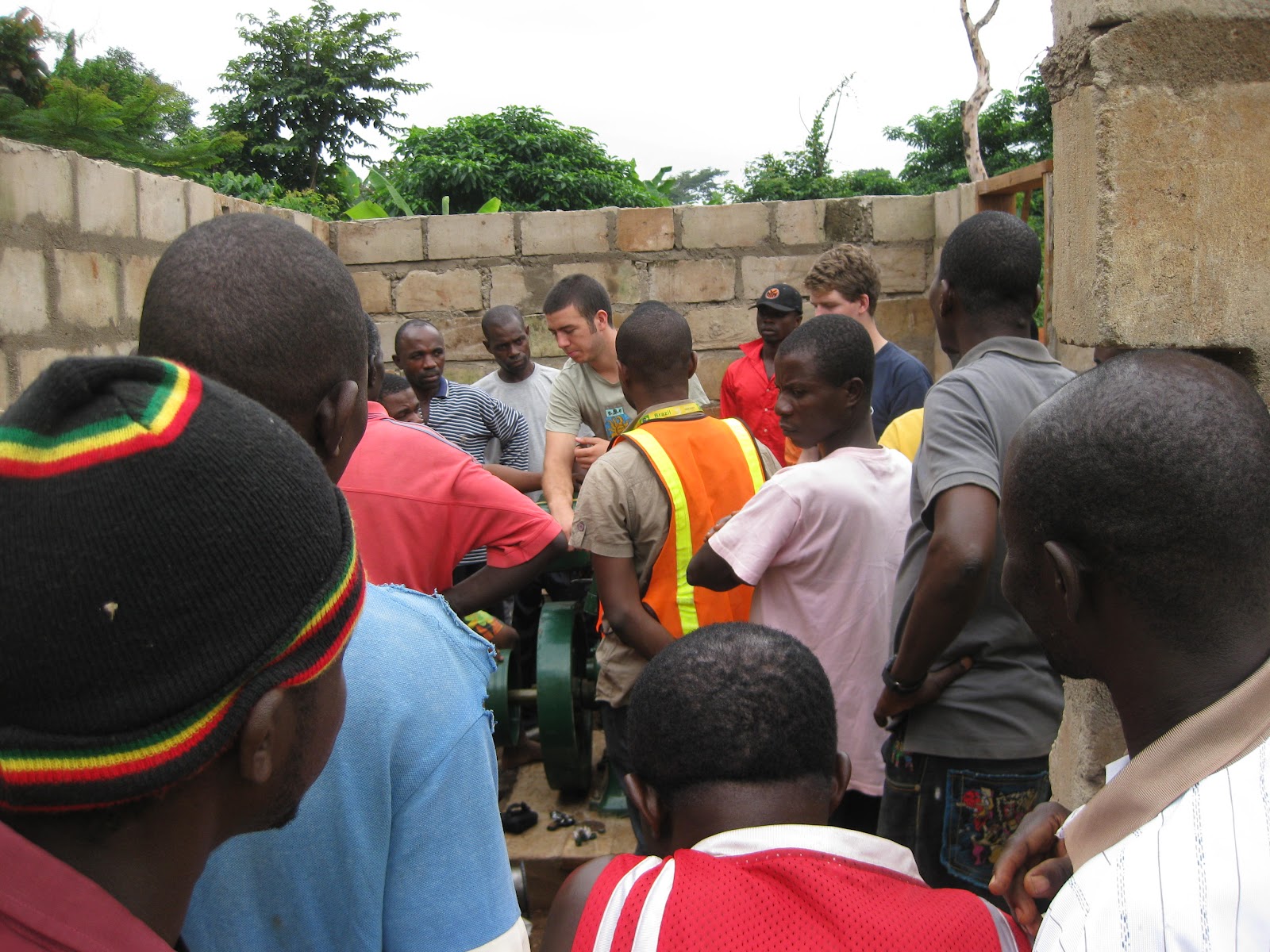
Going back to our village trip, we arrived at the village and we could see the small building they had constructed to house the lister engine.  They showed us inside we could see the villagers had already poured a concrete base and mounted the engine in position on top of it.  By luck there was a man in the nearby town of Ankrankwanta who had years of experience working with the kind of engine similar to ours, and he was a great assistance.  With a fresh can of diesel, motor oil and a little bit of cranking, the lister engine originally ordered by a previous Pavlis group started chugging happily away.
Most of the rest of our work was letting Peter set up the wiring and breakers to deliver power across the yard to the clinic, and setting up and mounting the generators itself.  We spent a while trying to communicate how we wanted the generator placed in relation to the engine, where the studs needed to be to secure it, how to align the belt, etc.  Nearly 20 members of the village surrounded us whenever we worked around the engine, and there was a lot of discussion in Twi we couldn’t catch over the plans we suggested.  Even the local village chief, Nana Yeboah, was into the discussion, and once we had established the spot for the generator and they began to pour the concrete, he was right down with everyone working and getting his hands dirty.
Mike working on the engine with an audience
Unfortunately one thing that went wrong was that the coolant system Mike had envisioned did not fit to the lister engine, and so we will just need to find a few parts in Kumasi and then return again for a day trip to set it up.  The concrete for the base did not dry during our stay, and so we also need to return to actually test the generator.                       
Our plan was to stay two nights in the Kwame Yeboahkrom and leave on the third day, so we stayed inside the spare rooms of the clinic that were kindly offered to us.  During the night of the President’s death we were invited into the downtown area of the village to have dinner at the chief’s house.  It was fascinating to actually be staying in one of the more remote villages in Ghana and seeing a little bit more of what life was like day and night.  Outside the chief’s house we waited for a while under a solar-powered street lamp and a good number of the village residents came and gathered around the area to take a look at us.  The children got a big kick out of our attempts at Twi and many of the older villagers were fascinated by Helena and Chelsea’s hair.  After the dinner of rice and hard-boiled eggs with spicy tomato sauce, the village had a small funeral celebration dance in honor of the late President Mills.  Govina was still with us, and pushed us to lead the dancing.  The music was loud and a lot of people showed up to join or just watch the obroni trying dance the popular Azonto dance.
The following morning before we got to work, Nana Yeboah showed us around his village.  The first day he showed us a cocoa plantation, and we learned that the majority of the people of Kwame Yeboahkrom are cocoa farmers.  We had never seen anything like the big yellow and green pods sticking out of the cocoa tree trunks, and later Nana invited us to try some of the dried beans from the pods that tasted exactly like unsweetened chocolate.  The next morning he showed us the palm farms, where the trees were either cut down and tapped to harvest the sweet and tangy sap, or left standing to produce palm fruit, then processed into palm oil, an extremely popular cooking oil in Ghana.

Dried cocoa beans and two picked cocoa pods pictured
Written by Clayton